#03 Weekly Thesis Updates!!
Saturday, September 5 - Friday, September 11 -
This week involved waiting on orders, checking inventory, designing and finalizing before ordering yarn, and brainstorming furniture solutions. It also consisted of checking old code - looking for old projects, brainstorming new ones, and ways to connect the systems. Finding ways to change the style of old projects to fit the new direction, adding the chosen color palette to all of the work, and ideating through doing/coding. I realized I work significantly better when I work on something, see how it functions, and build from there!
Chosen/Final color palette
This was derived from the completed rug - originally the yarn shopping list; it started in a shopping cart where I was comparing colors to see which colors best complement one another and the design. Now, with slight changes, considering they have been digitized, with 1 exception: a light beige color to replace the white - to add a little contrast to the white design & to provide more contrast on screen in any digital system/work.
The colors will carry over into completed work and new work for the thesis [More on the significance later through the weeks].
*Photo of the weekInspiration column
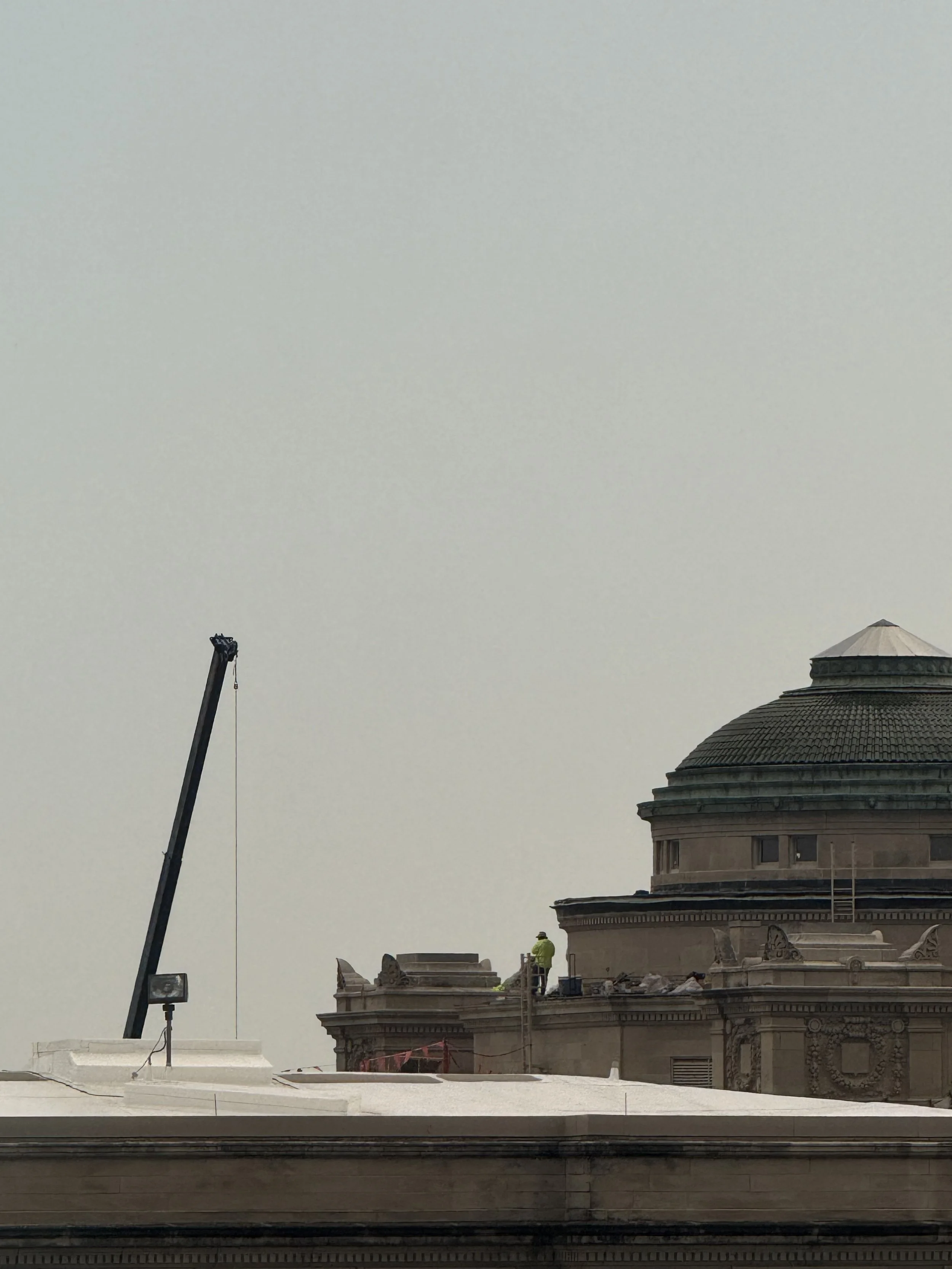
Campus Construction
Rugs, Exploration, ideation, and design process
Saturday, September 5 -
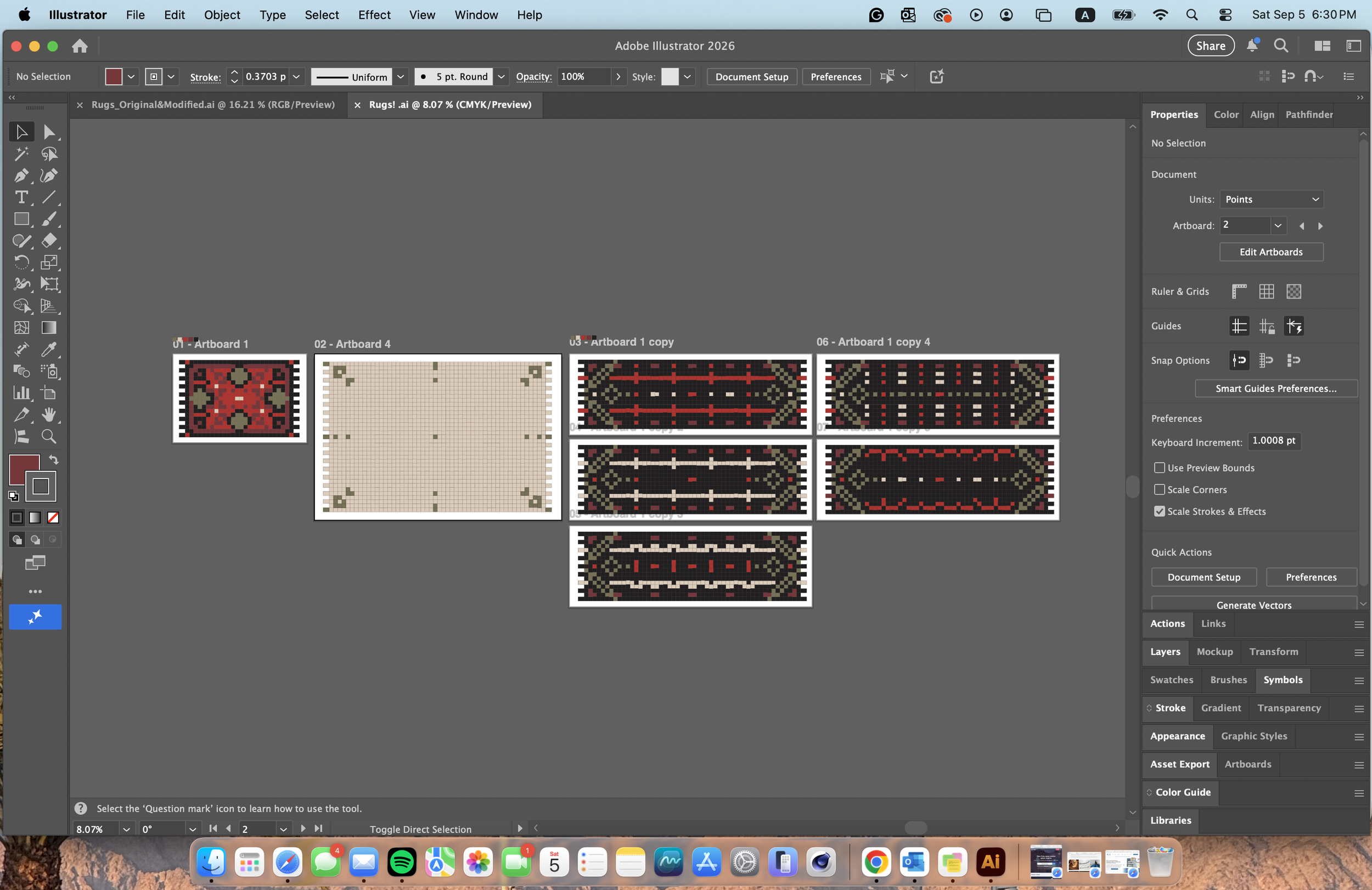
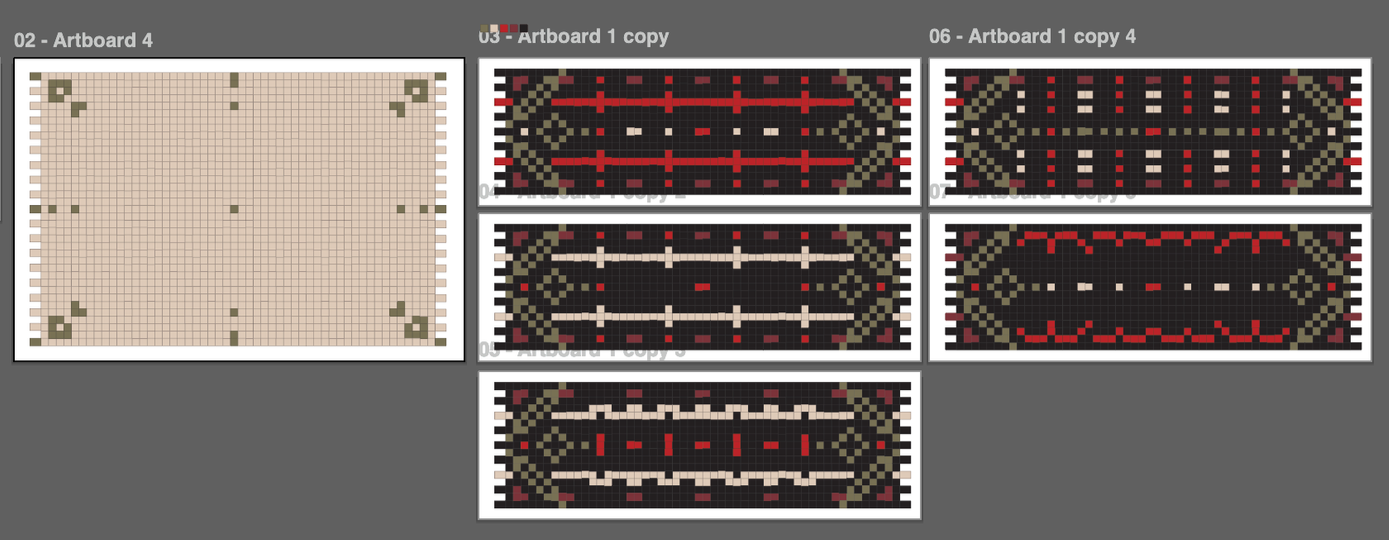
02 - Artboard 4: The rug in this collection that looks the least complete is actually the most complete. The rest of the options from 03 to 07 are all variations of one option - something I decided I needed to spend a little more time on. Choosing the final design needs more research and calculation. The rug representing 03 to 07 needs to invite people to step onto it; its job is to visually communicate that you are meant to and allowed to walk on it, an experience that goes against everything we feel we are allowed to do when walking into a gallery. I also need to consider that many people, myself included, will feel as though they are not allowed to walk on a rug with their shoes on. Arguably, the most important part of the design is communicating all of that with as few instructions as possible.
Whereas 02 - Artboard 4: the first rug on the left - the option that looks the least complete is actually the most finished. The idea for this rug came from a long discussion and meeting with one of my committee members Johnny Diblasi - the initial/proposed idea was to have another rug on the ground one people can walk and stand on - as soon as someone stands on the rug a connected projection on the wall infront of the rug reacts to the person, creating patterns and changing colors based on where that person was/stood, I also proposed that once another person is added to the system - someone else also stands on the rug the reaction changes, evolves the same way the rest of the systems react and change throughout the thesis/exhibition space.
This, however, changed after a long discussion about the details and technical portion - camera positioning, how the program will work, how many cameras I would need, how complicated motion detection can be in a busy space, etc. This all led to placing the rug behind the participants and the cameras - meaning there would only need to be a camera in front of people and not from multiple angles. This also eliminated the hesitation people might feel about stepping onto another rug and opened up the possibility for new designs—the new direction: participants’ hands move over/in front of the rug behind them. Creating a system that makes it look like the colors on the rug are changing. Again, adding more people to the system would change the reaction once a new person is introduced; it would function differently. Maybe the shapes change, the colors shift, the ways the colors are moving across the screen change- all details that will be worked on further into the design process. But this means the rug behind them needs a simple design to indicate where people need to stand to be detected, while leaving room for different colors to show clearly and vibrantly against/in front of the rug.
Rug #02 - P5.JS Sketch
Sunday, September 6 -
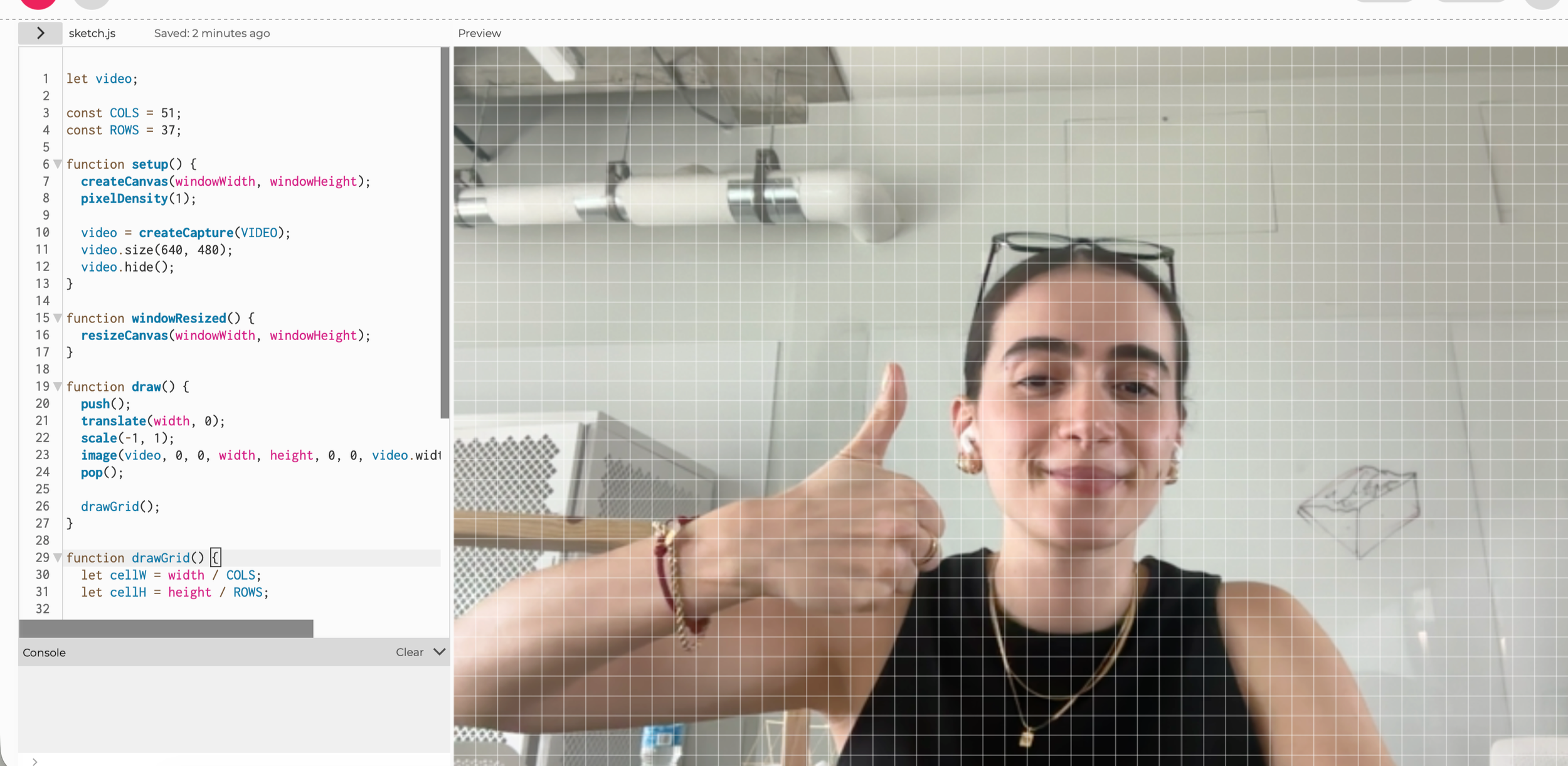
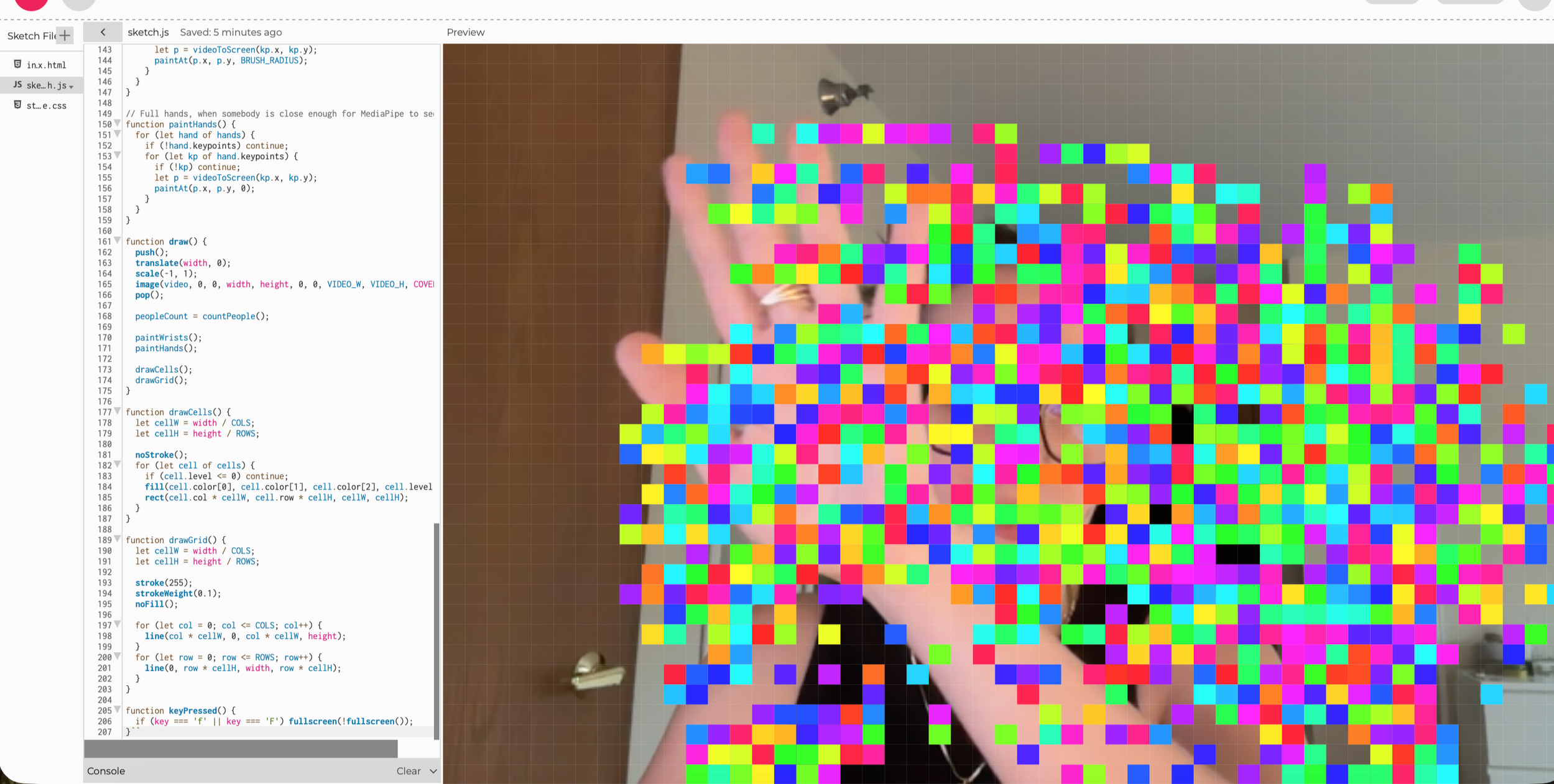
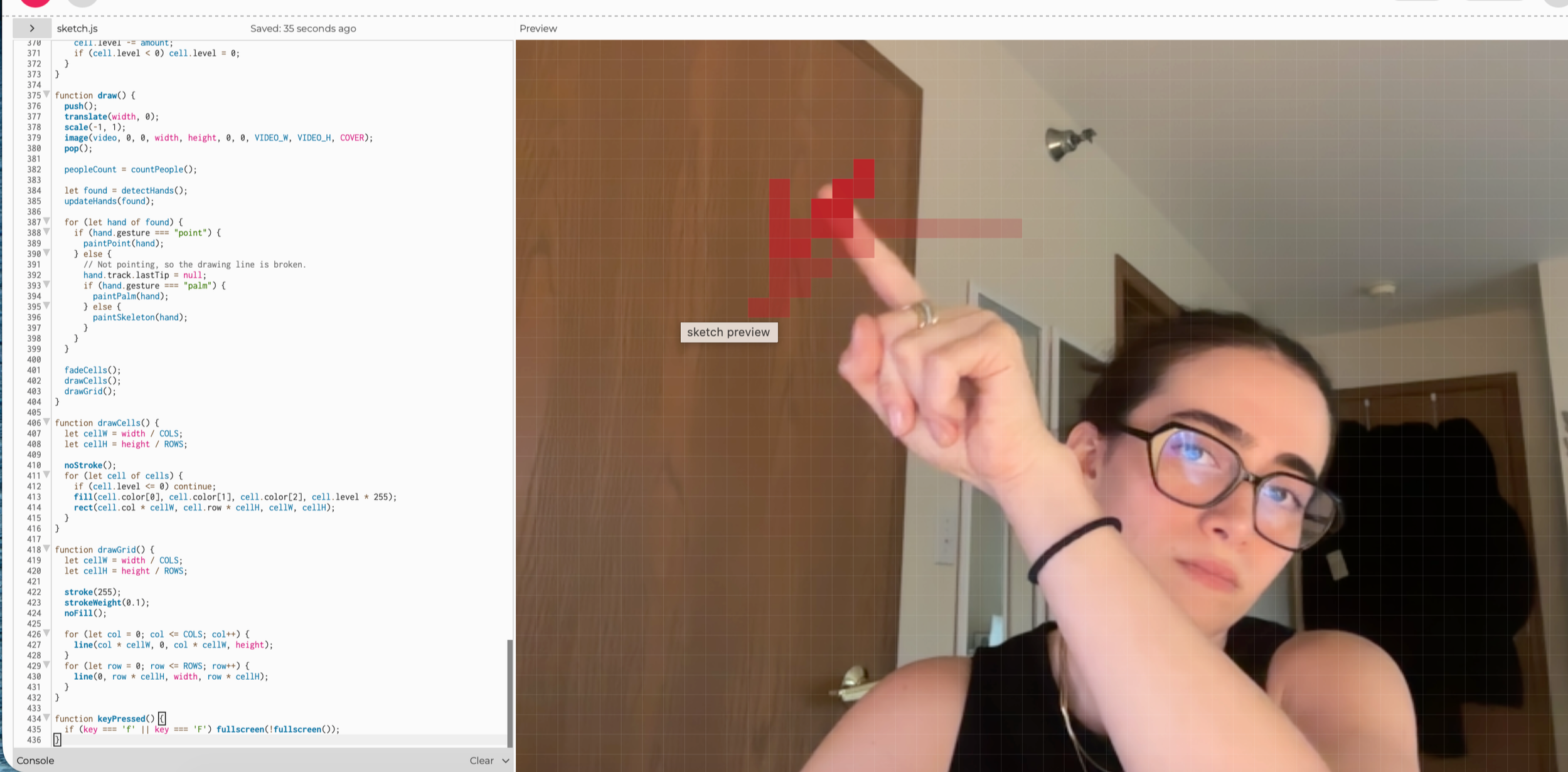
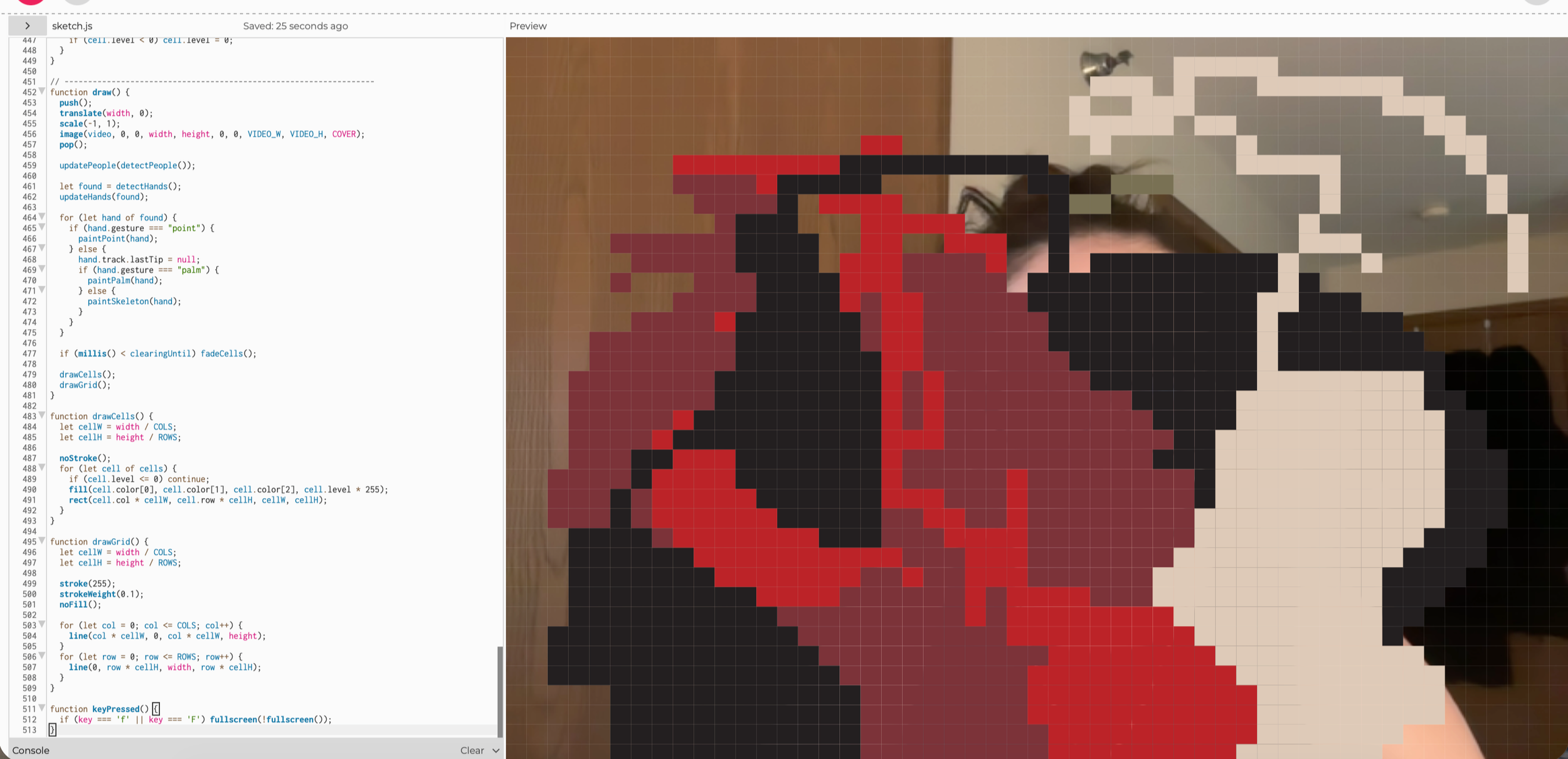
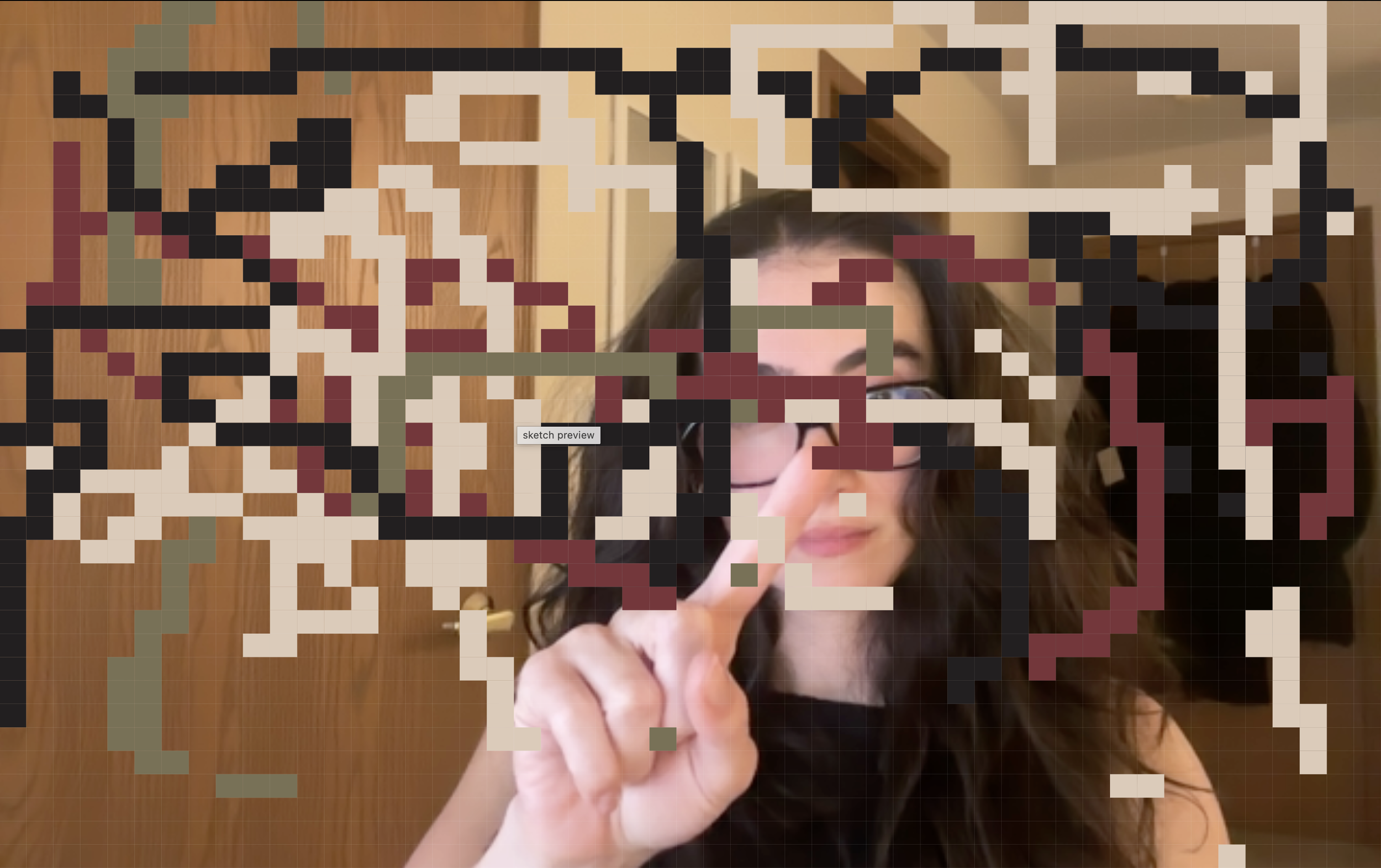
In the process of ideating by doing in this draft sketch seen above I was atempting to add in a section that doesnt allow users to change the colors of the squares anywhere they land right infront of them [infront of a detected body] - that lead to the realization that I don’t need the projection to show the feed, I need the camera to detect the bodies and hands & I need the projection to be pointed at the plain rug [ 02 - Artboard 4 ].
Monday, September 7 -
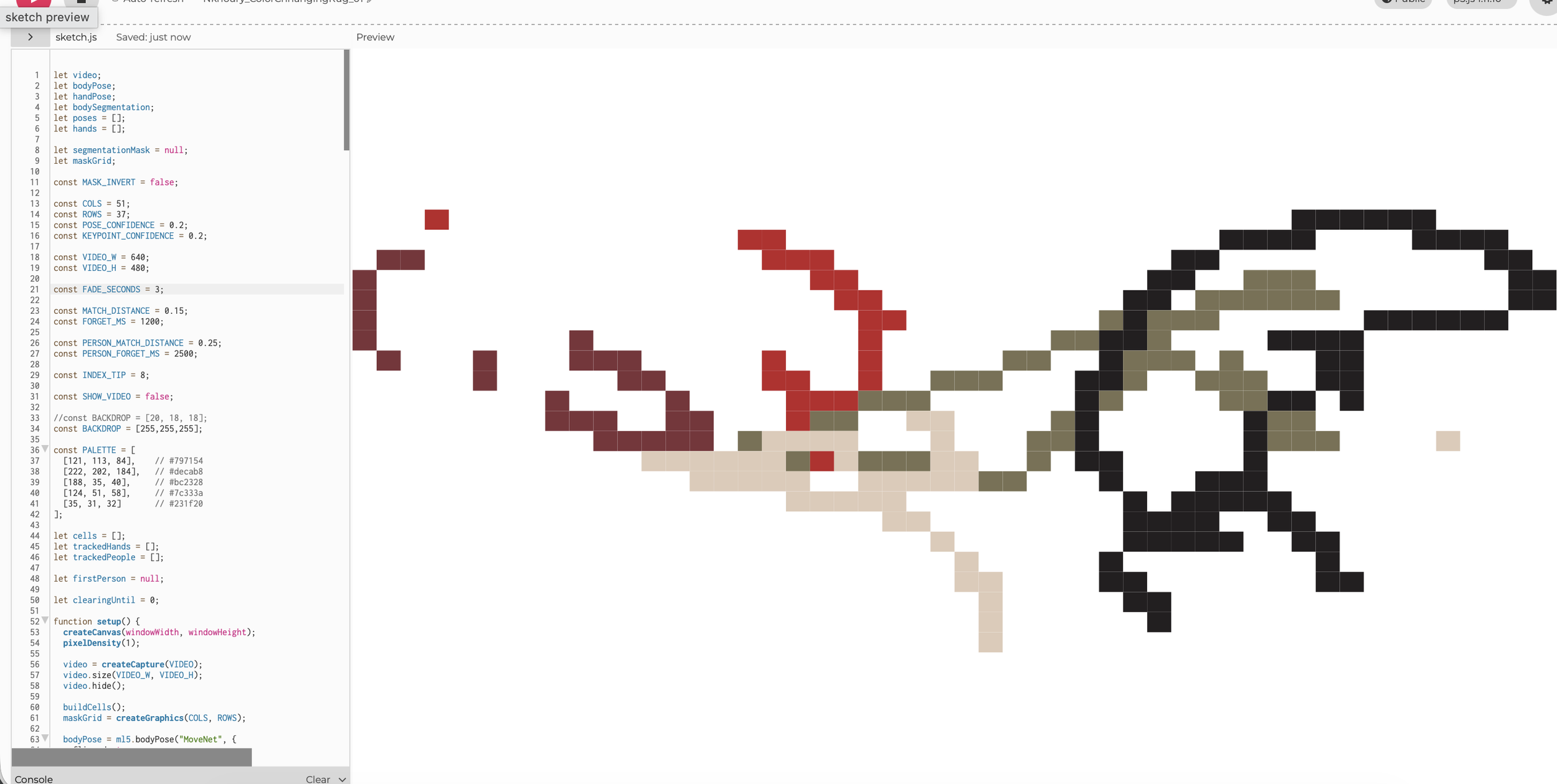
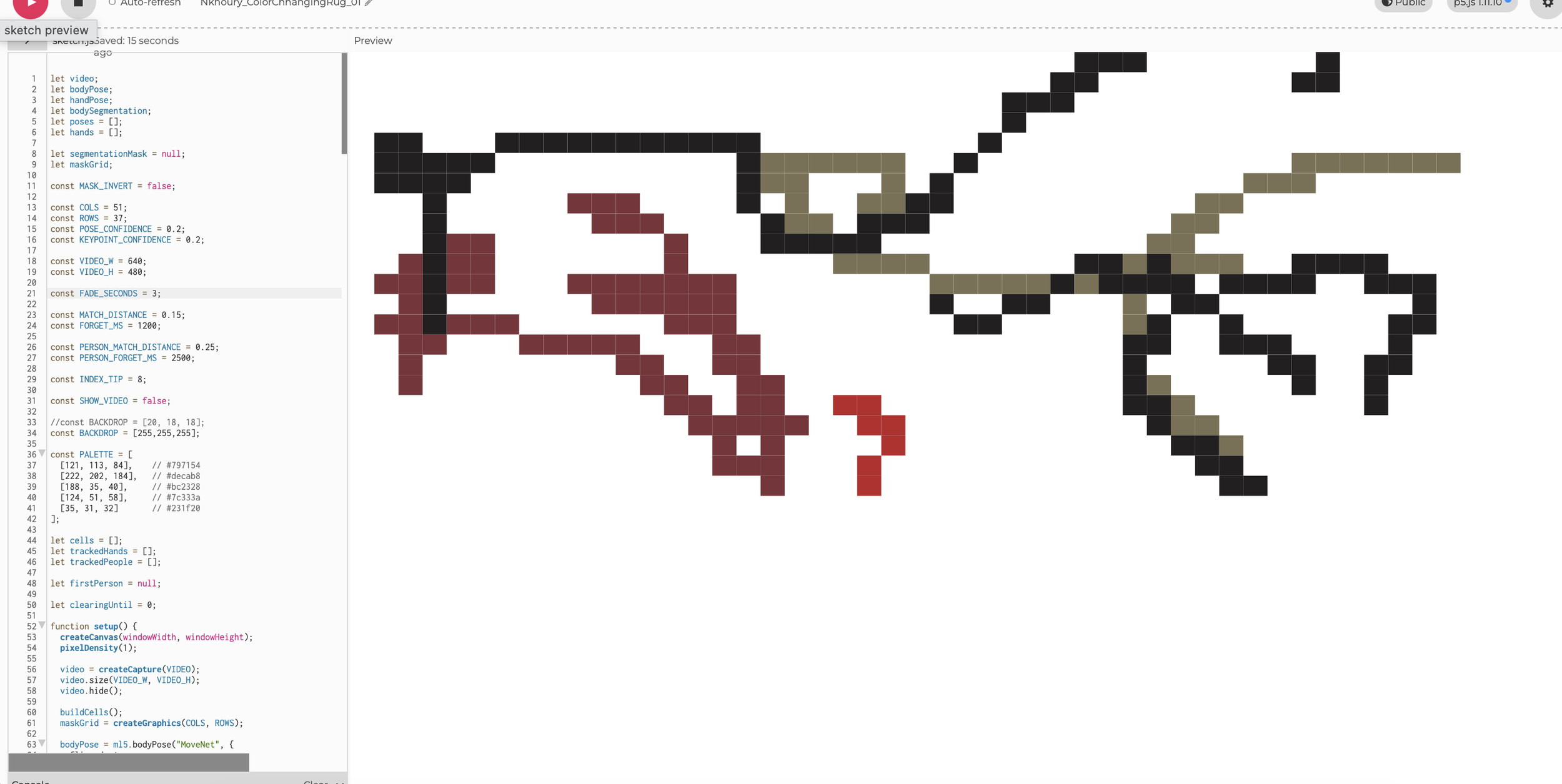
While testing out this version of the sketch - the one where the camera feed is only used to track bodies/people and hand movements- I realized there needs to be some cursor or indicator of where your hand is on the screen; the millisecond delay of your finger being in position and the colors changing is distracting enough that I was constantly thinking about where my hand is.
Monday, September 7 -
Working on the new sketch lead to check on where some older work was - if I still had all the necessary code, if there is anothing new that I have learned since the project that I could apply - any de-bugging that needed to be done..etc.
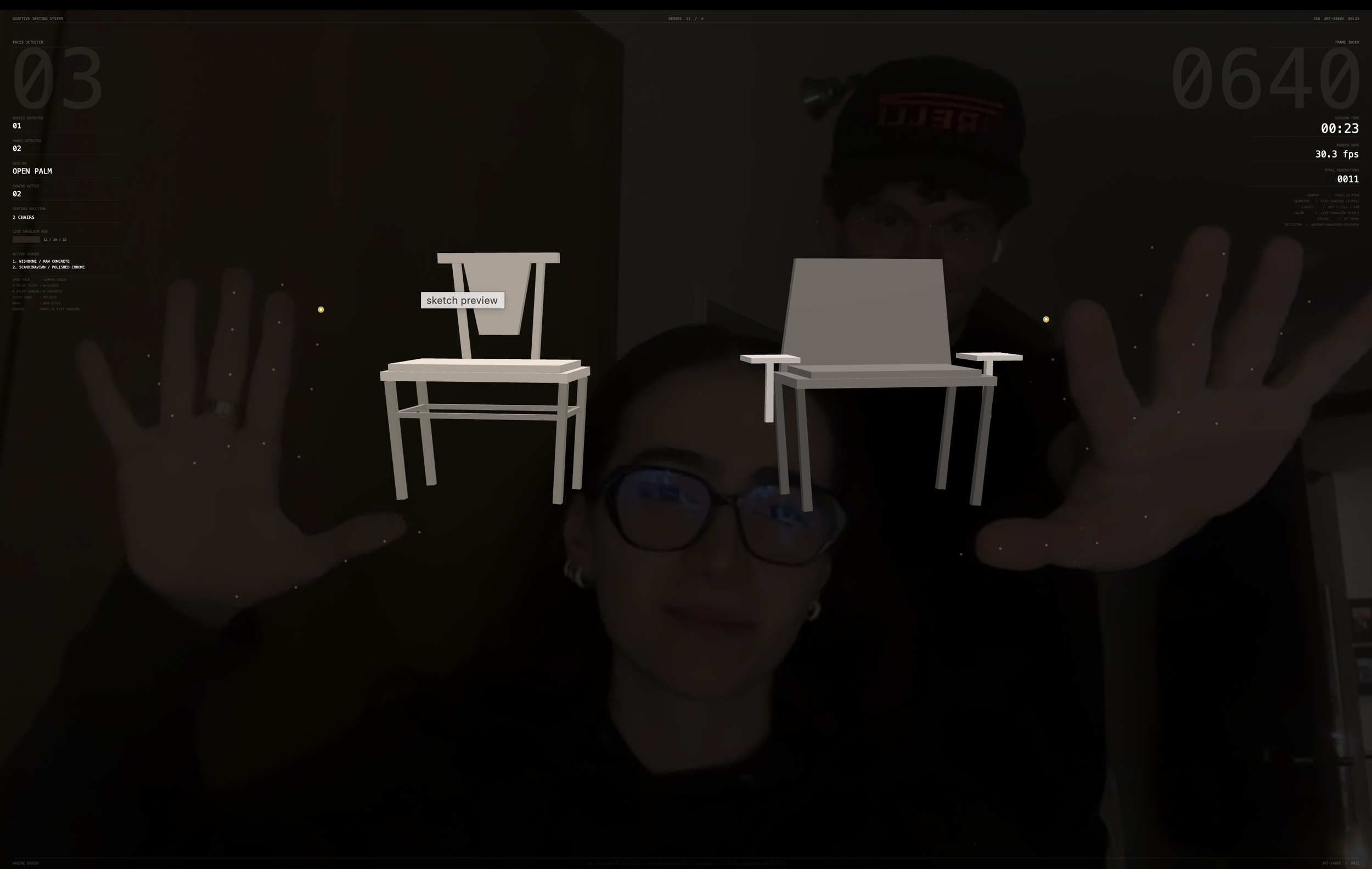
All the code was still running smoothly, and I was able to transfer it to P5.JS, keeping copies in multiple locations as a backup for the backups! Everything was running smoothly the way it had been last semester; the only issue I have been facing is the primitive nature of the designs/models of the chairs - drawing the furniture using code created a very primitive look, which I want to move away from. The project can still detect multiple people and function with many hands - for some reason, the system thought there were 3 people instead of 2 in the test above - so I either have a small issue with my code or a ghost.
Some changes to be made/to-do list:
Re-design chair models [or find new solution if end result doesn't reach the goal]
Fix ghost issue
Increase text size ( + Remove any unnecessary numbers or statistics since this is the only project they are seen in and they do not contribute to the larger thesis direction)
Monday, September 7 -
Some changes to be made/to-do list [final touches]:
Check why idle mode is no longer working the way it did before
Change color palette to the final chosen color palette
Change how the size of the particles remains the same/on screen if the hands are abruptly removed [watching video ending]
The chosen/final color palette
Tuesday, September 8 -
#797154
#decab8
#bc2328
#7c333a
#231f20
121, 113, 84
222, 202, 184
188, 35, 40
124, 51, 58
35, 31, 32
Green
White
Red
Maroon
Black
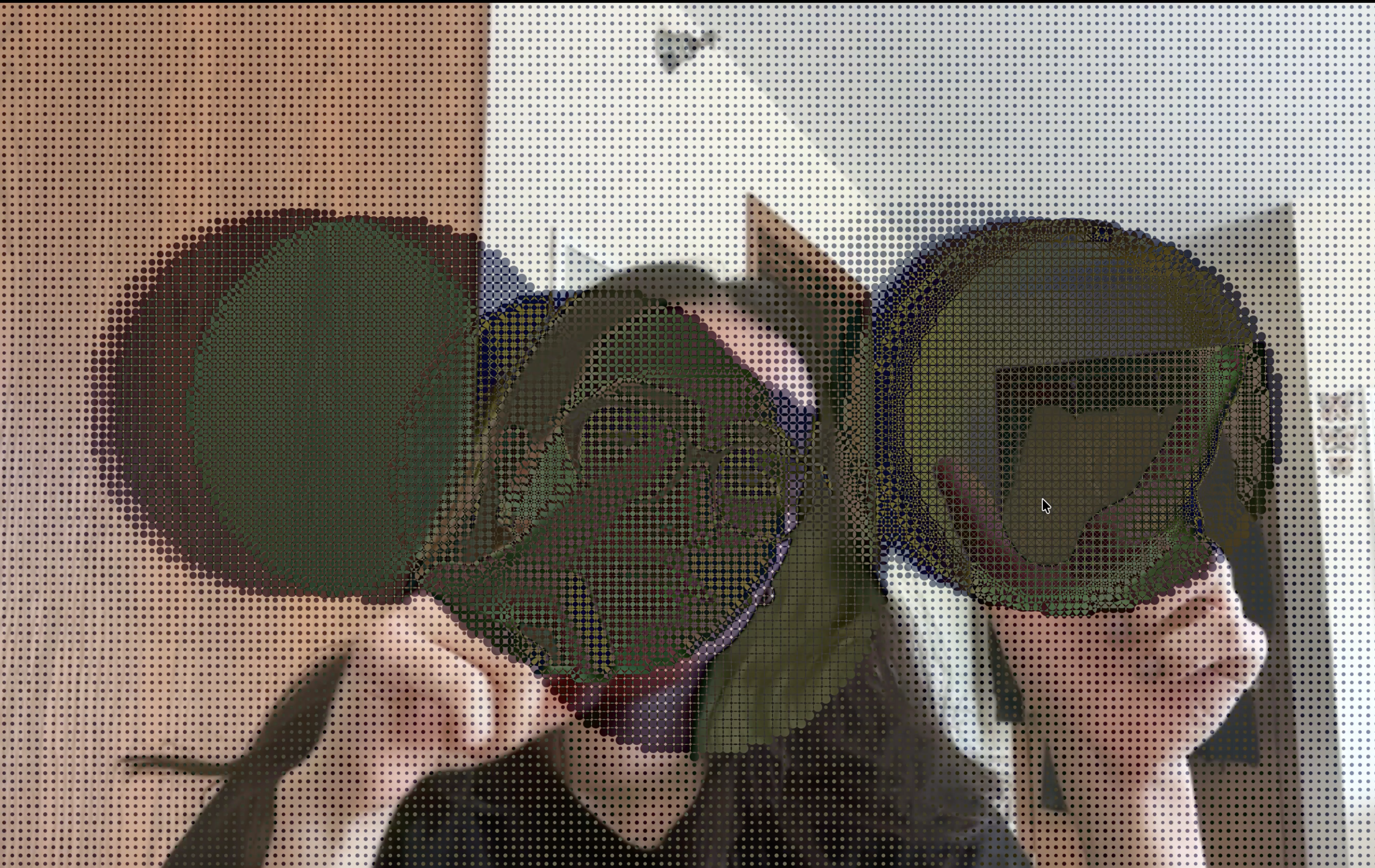
01. Green
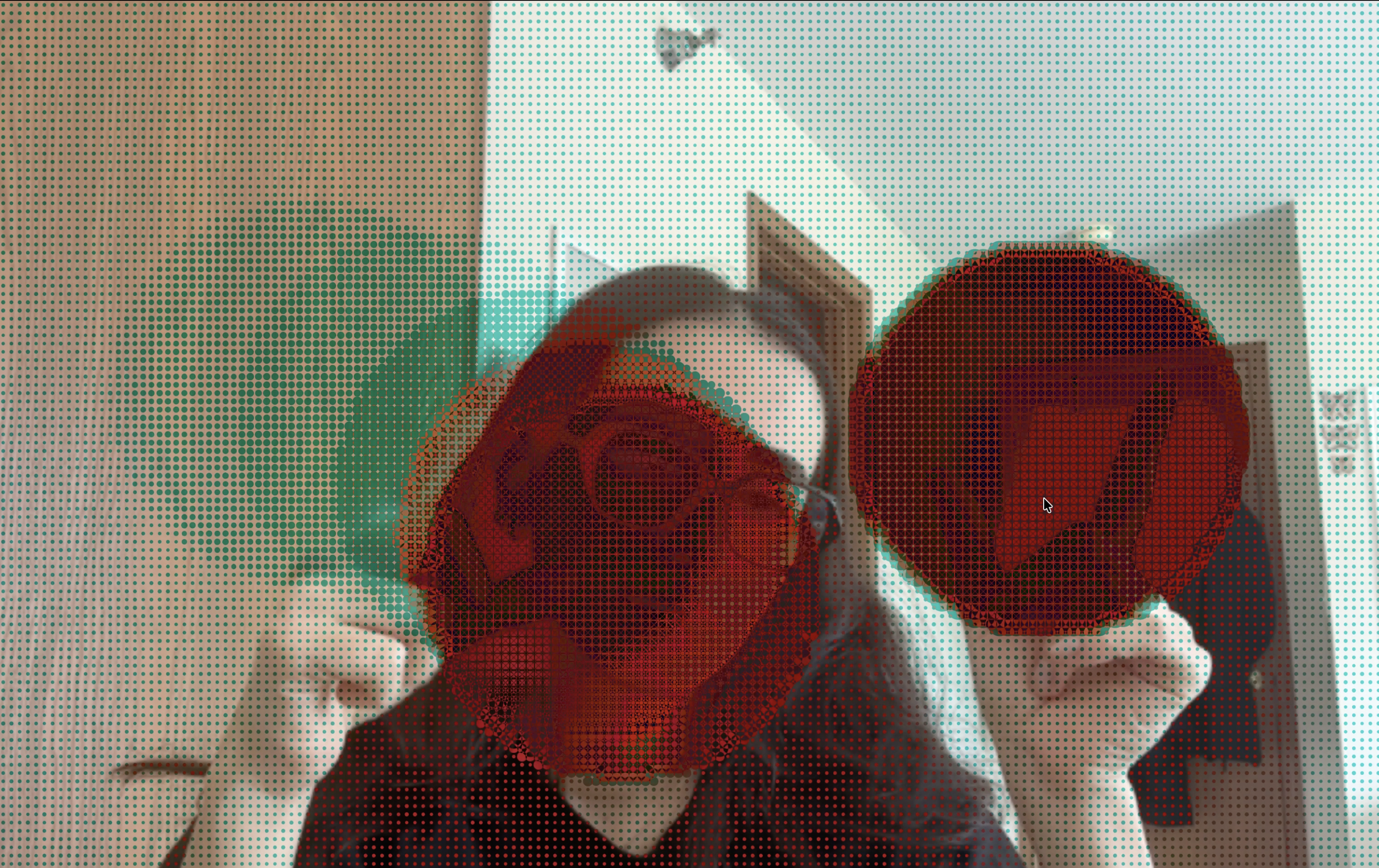
03. Red
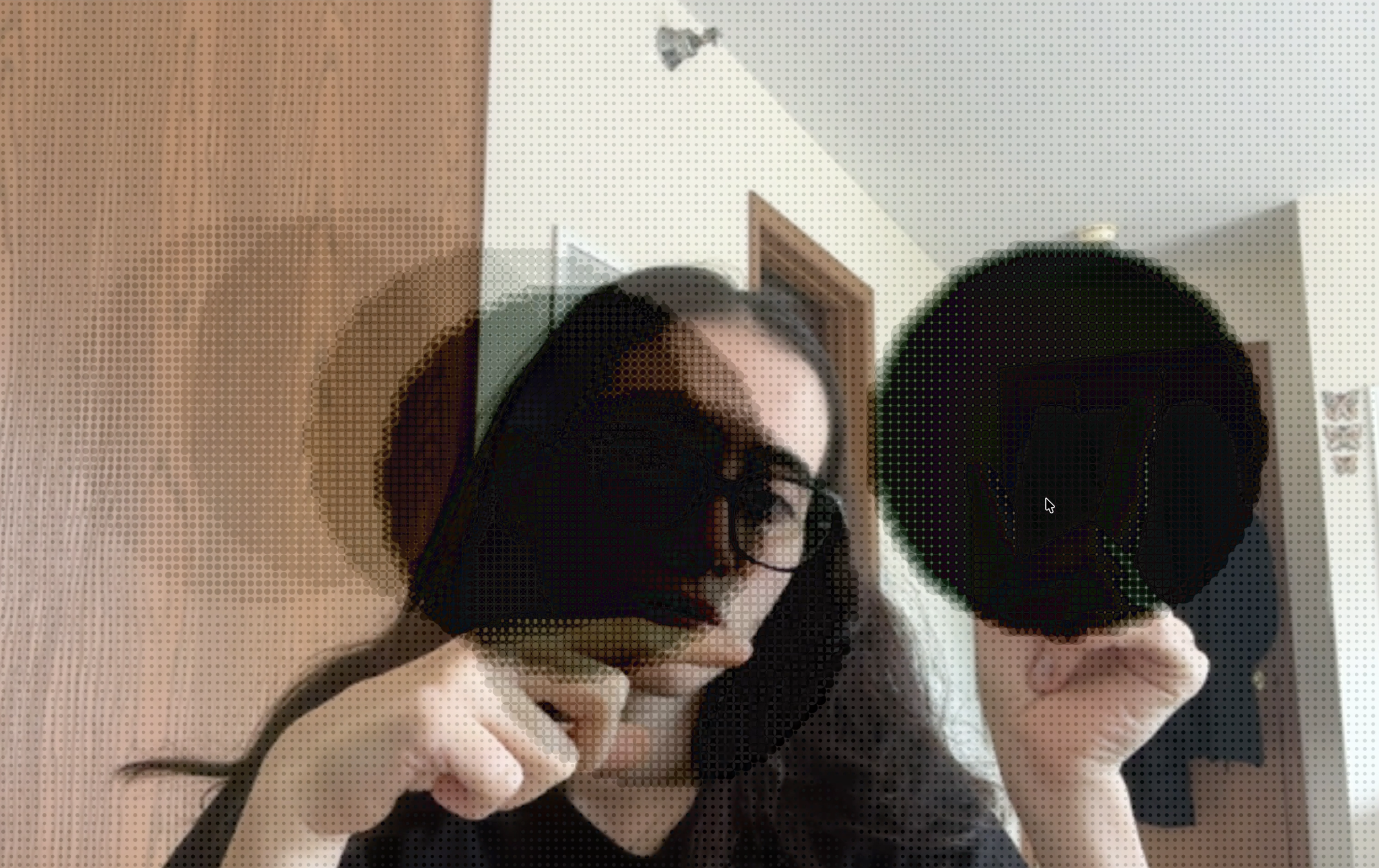
05. Black
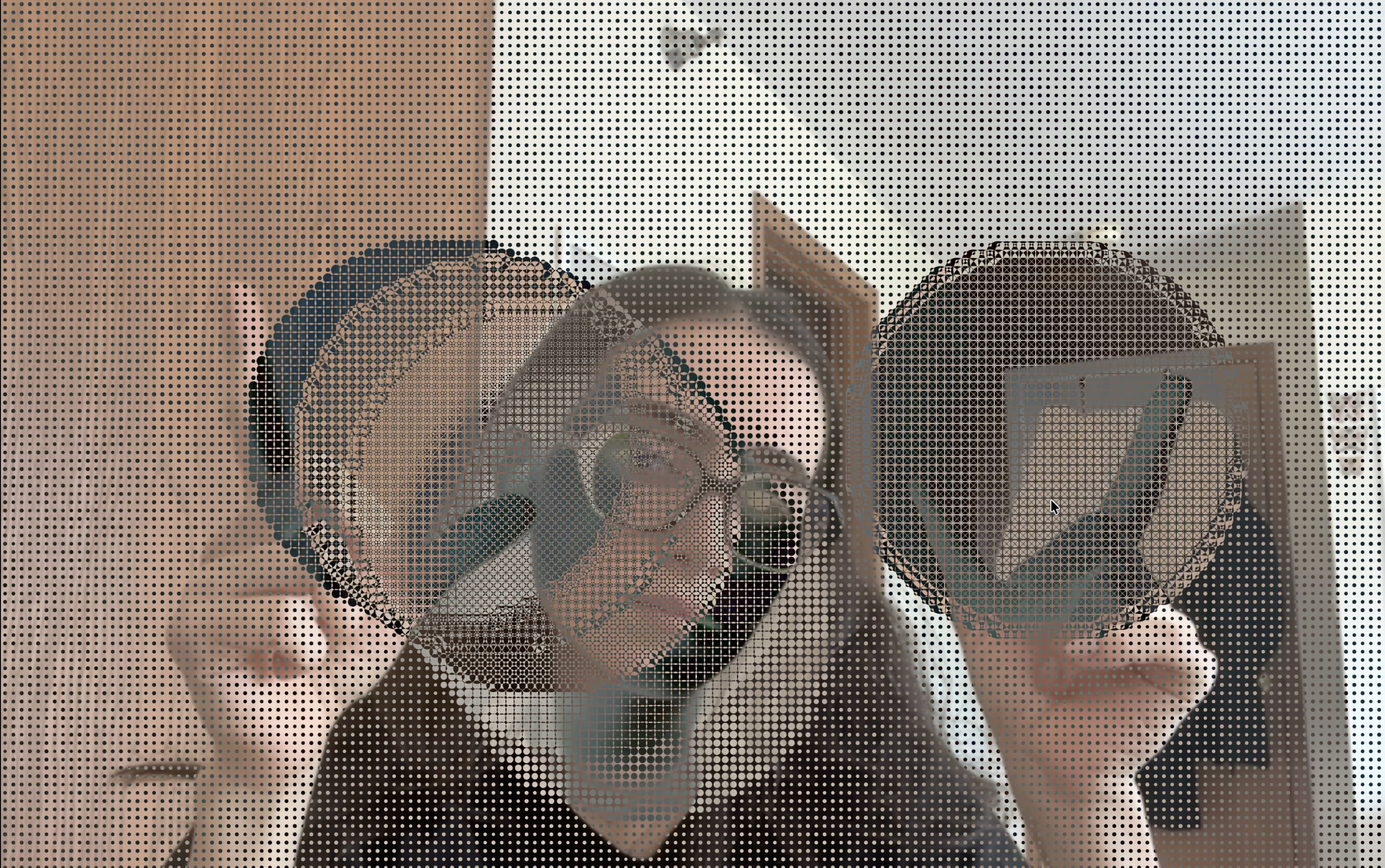
02. White
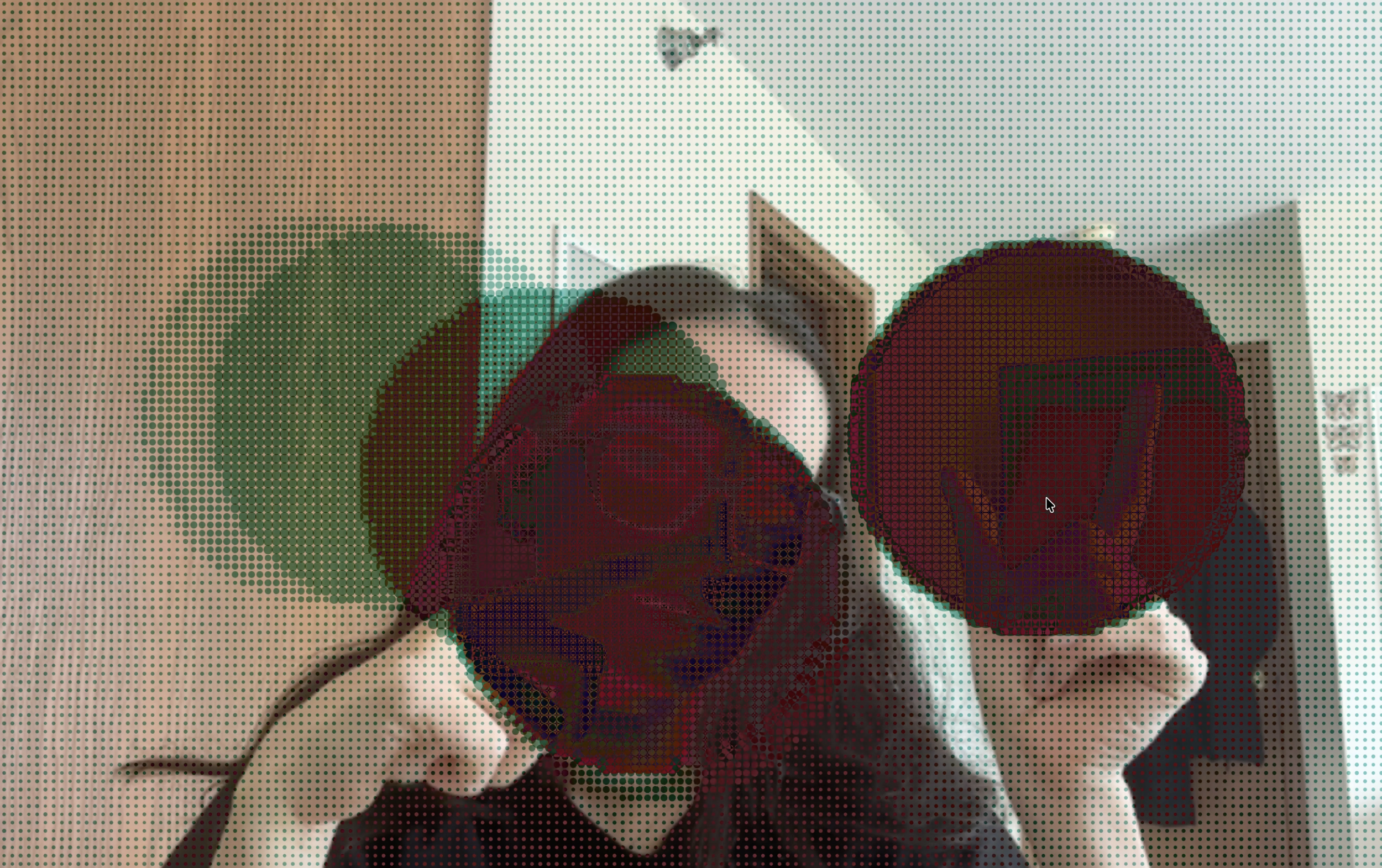
04. Maroon
The black [05] ends up too flat and doesn't create the same halftone-like effect as the other colors, so I decided to add another white instead! The white that was in the original color palette of this sketch/project.
There will be a few more variations of the color palette; the next step would be to add colors where the opposite/background color in the back is the one that relates more closely to the color palette, to add variation.
Committee Member meeting - discussion, brainstorming, etc
Wednesday September 9 -
https://madmapper.com/madmapper/software
https://madmapper.com/files/02-My%20First%20Video%20Mapping.pdf
During the meeting, I presented progress on rug project 02 and discussed the project's next steps and goals. From there, we discussed projection mapping [links above], some options, whether a specialized projector would be needed, whether running P5.JS would work instead of different software, and whether it would be easier to manually adjust the projector and make the p5.js feed look as tho its the exact shape of the rug using different colors, etc.
The main concern would be mapping the projection to the rug's edge; that would be the most important part.
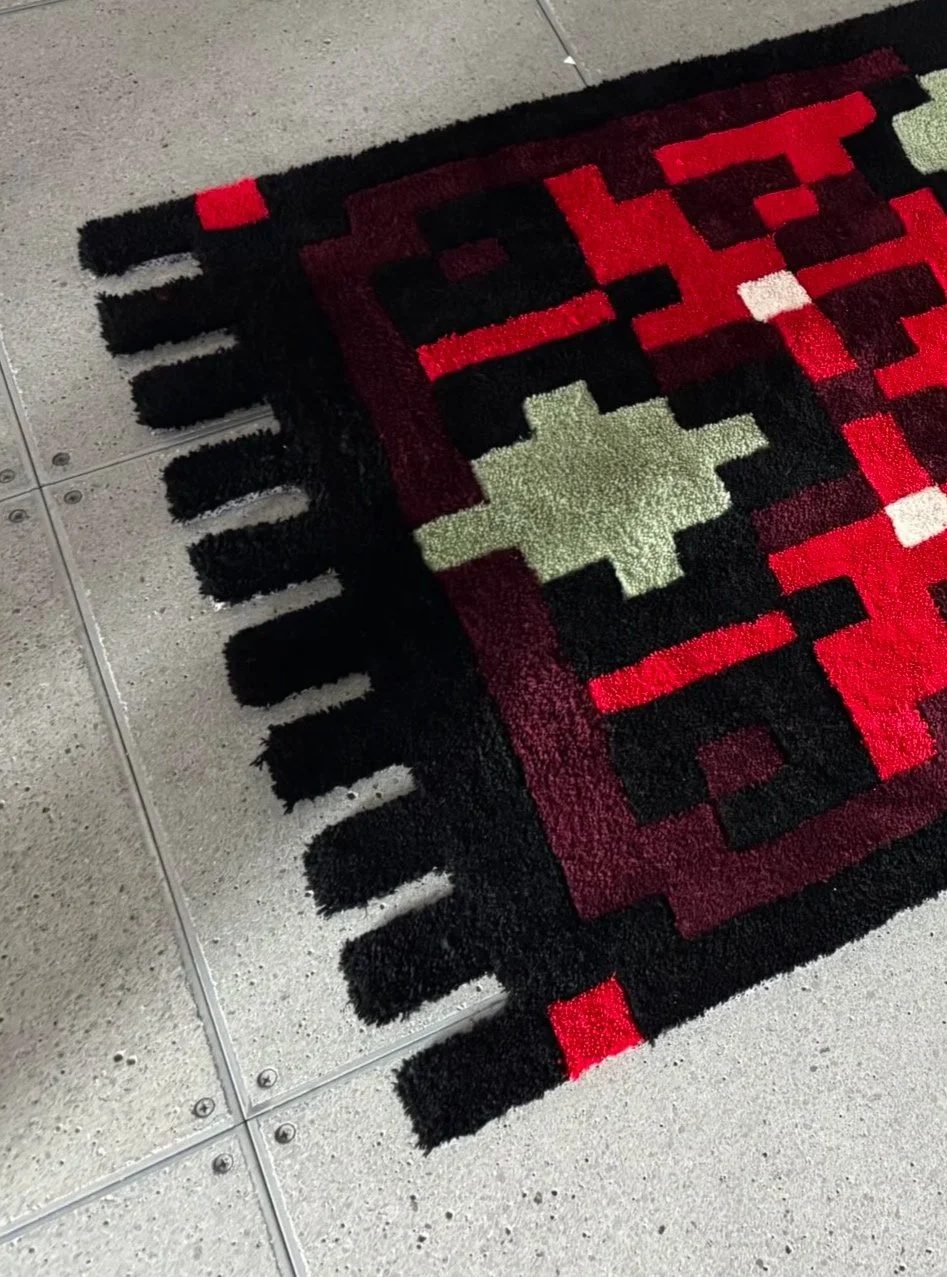
Rug 01
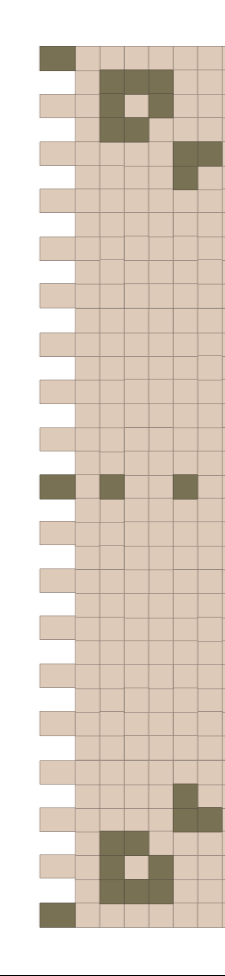
Rug 02 [ Adobe Illustrator ]
The meeting led to the conclusion that a small-scale test would be a good option - tuft using the stark white used in Rug 01 and tuft using a beige color for more contrast on the walls of the gallery to see which option would work better when projected on + use those samples to test projection mapping and manual projection setups/background color.
Thursday, September 10 -
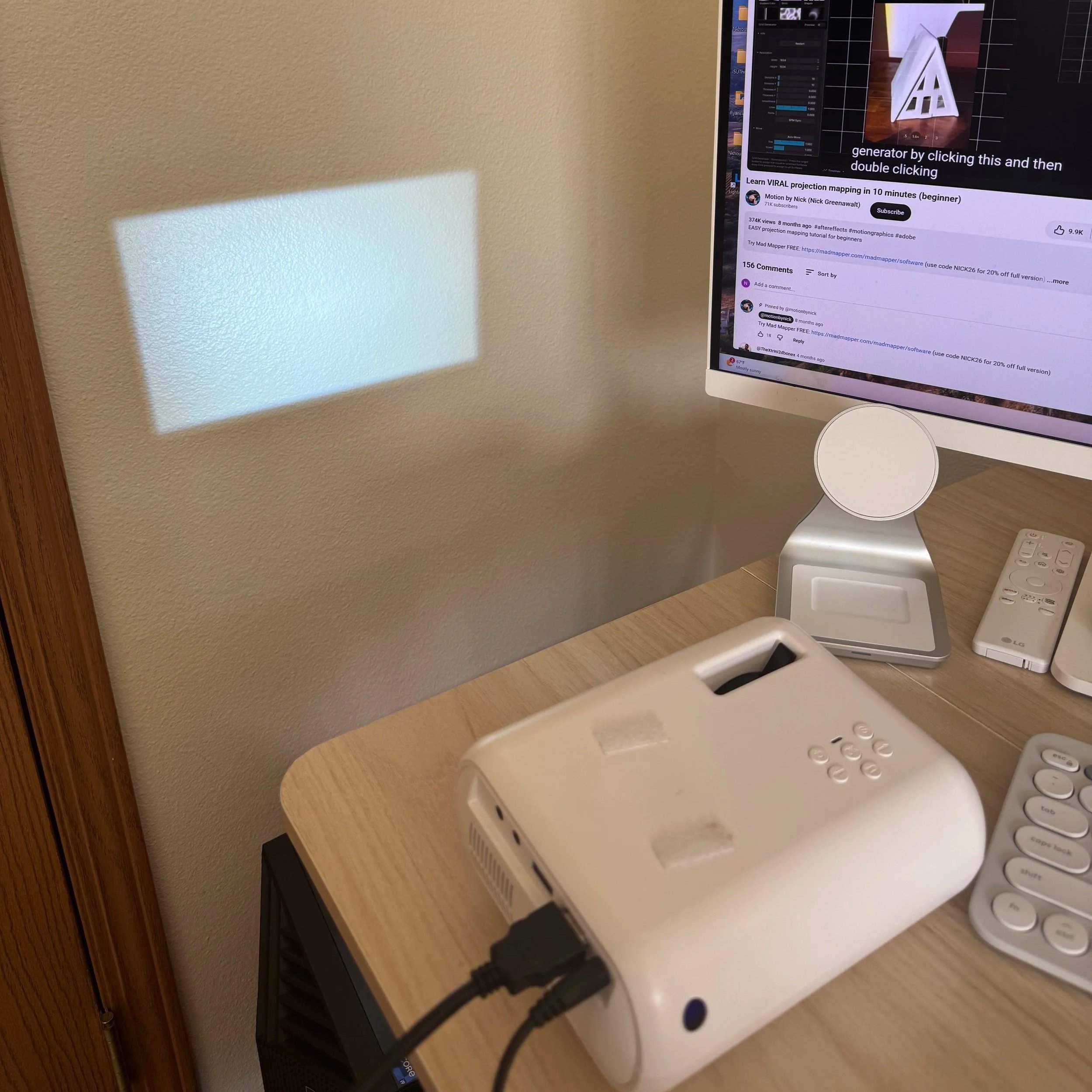
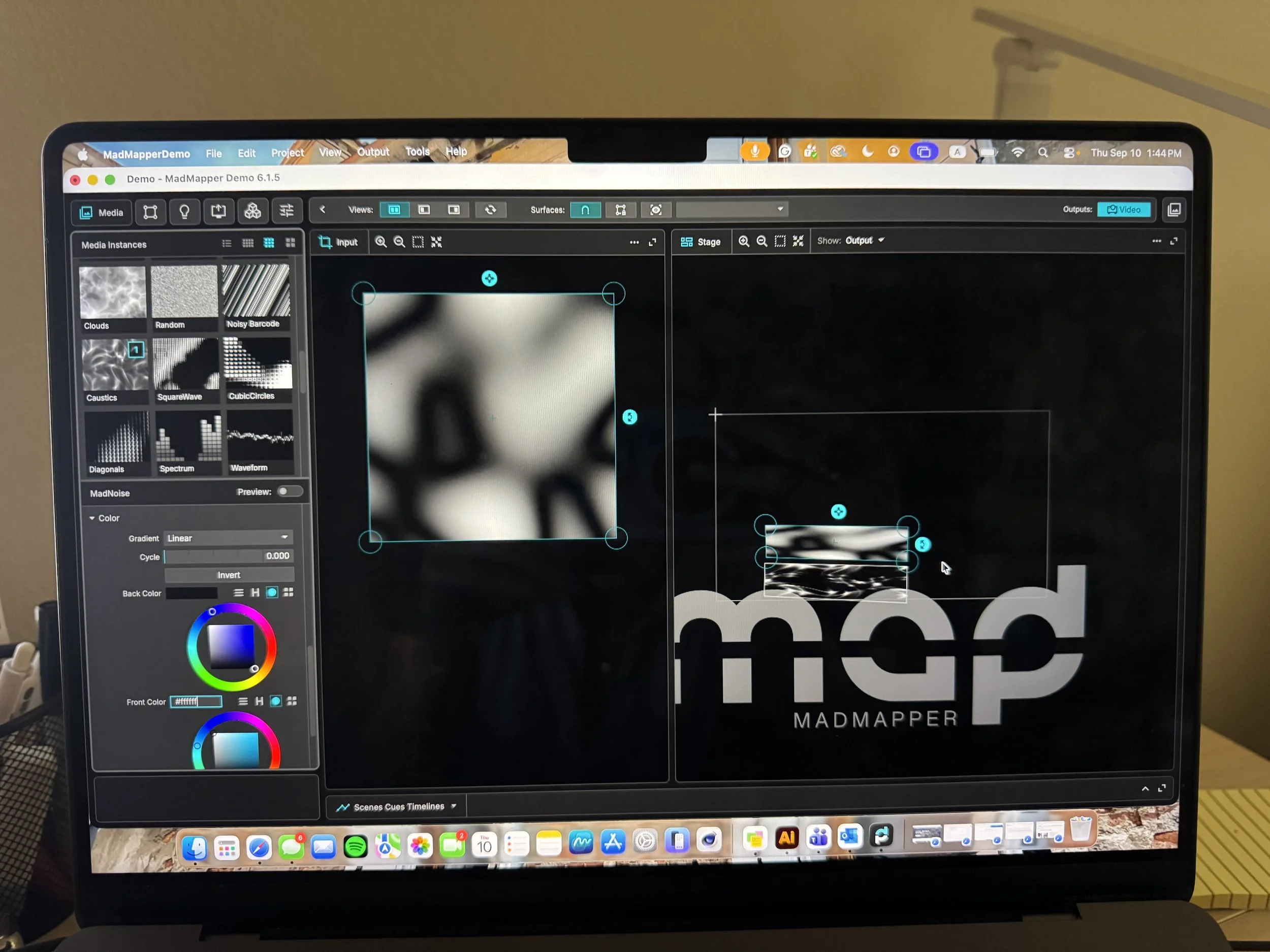
When discussing projection mapping with MadMapper, I couldn't help but wonder whether P5.JS could run the sketch/project live through MadMapper, so I spent some time on the MadMapper website. From there, I figured out that it is possible! But it would just be another system running in the background during the exhibition. After some research, downloading the MadMapper free demo software, and watching a lot of YouTube, it is clear that the manual option would minimize the risk of a crash and reduce any chance of lag or added latency. But projection mapping has been on my list for a while, and I think it will elevate the project, so I'll explore the software and push the project in that direction. If I find it causes the system not to function as intended, lag, or any other issues I’m seeing described online, I will move back to plan B [the manual option].
REVISITING OLD PROJECTS - INTERACTIVE INSTALLATION
Thursday, September 10 -
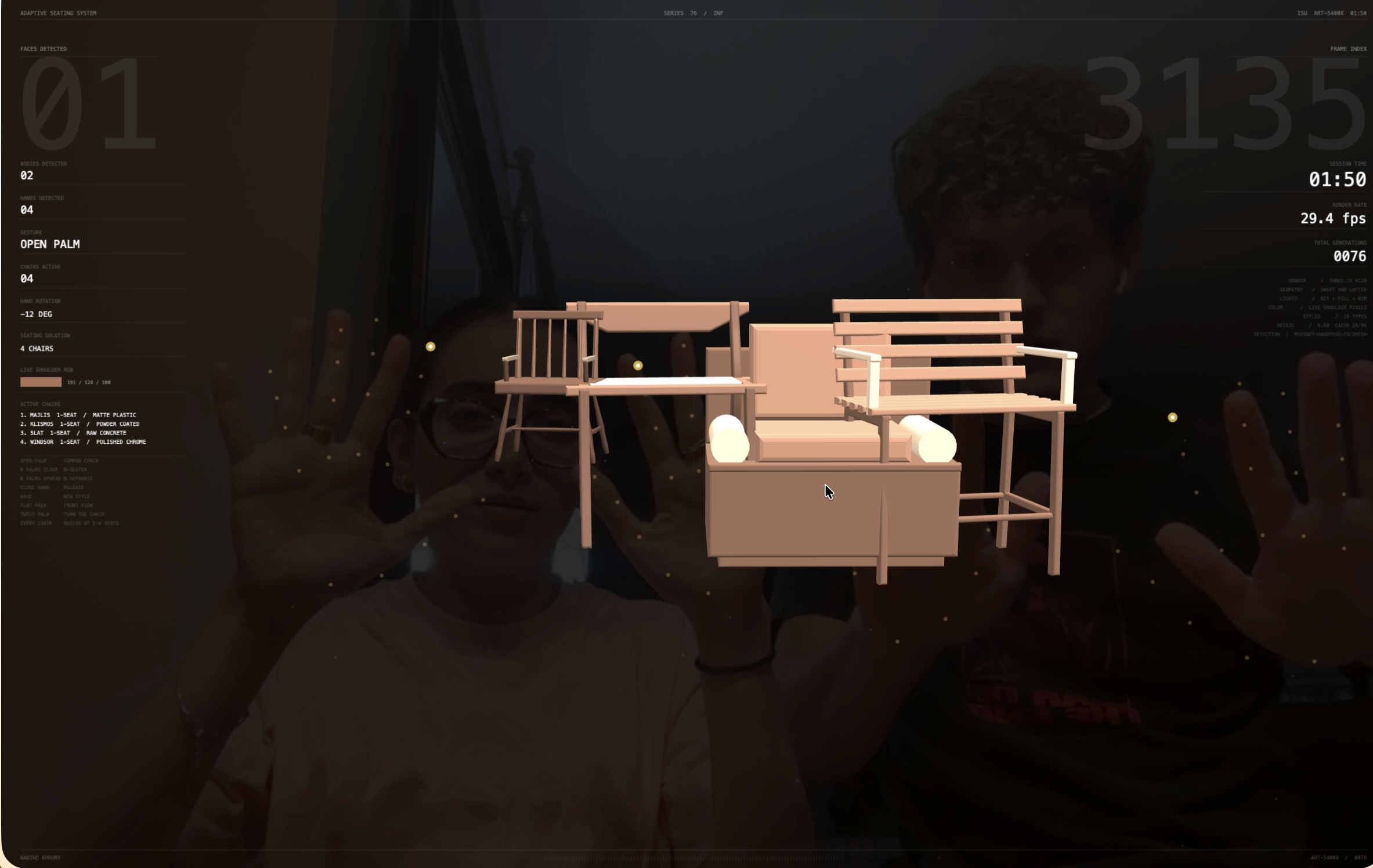
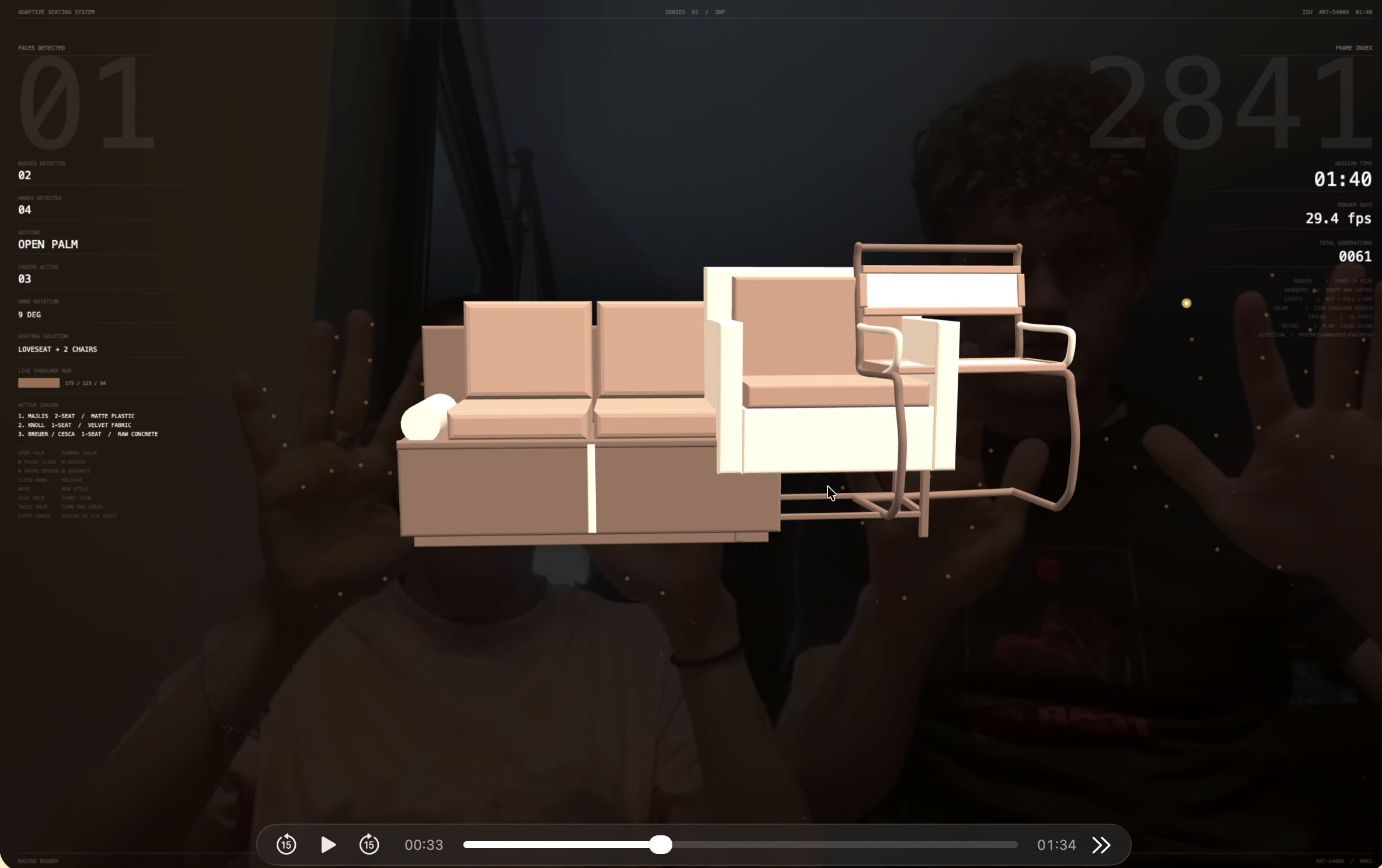
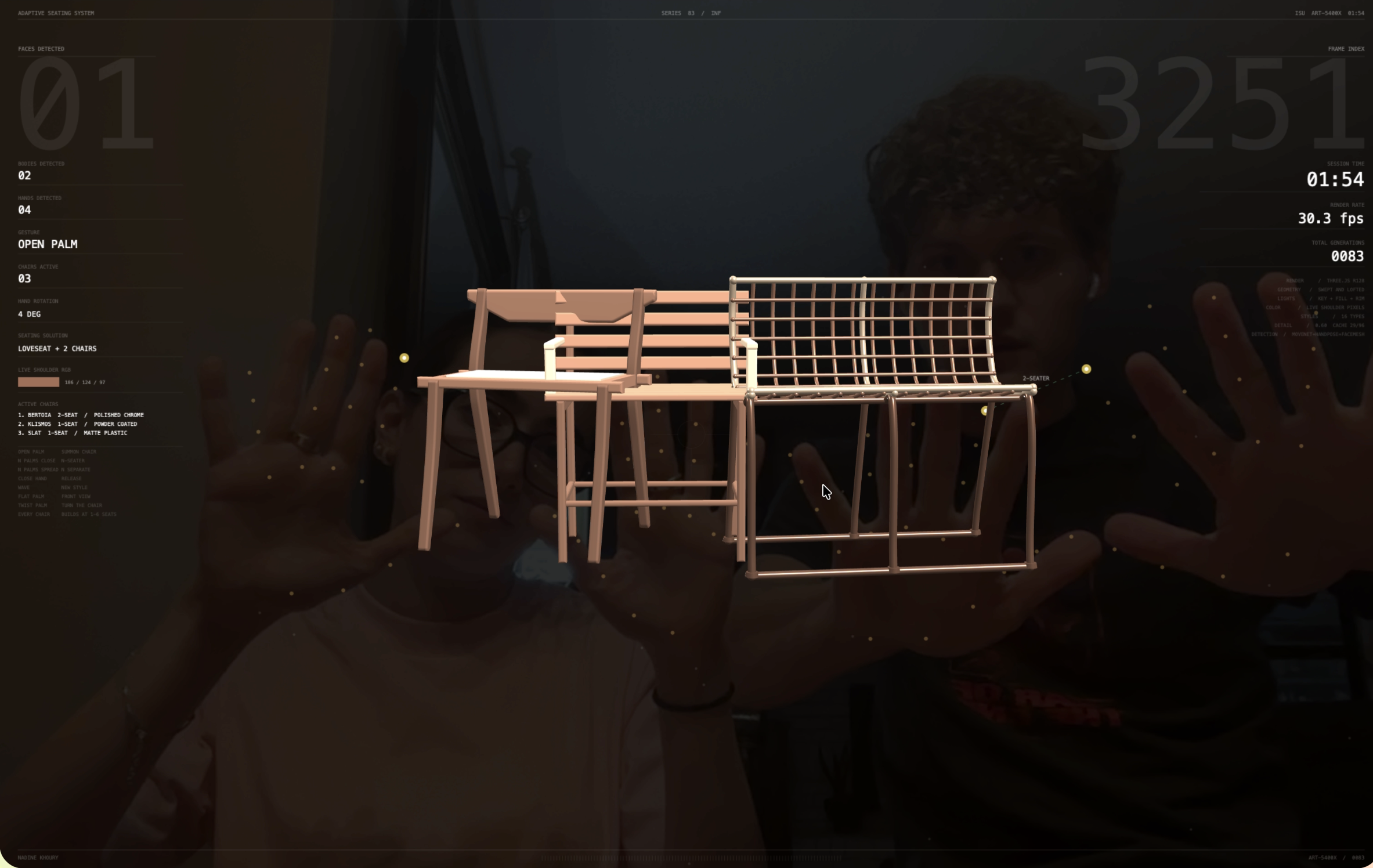
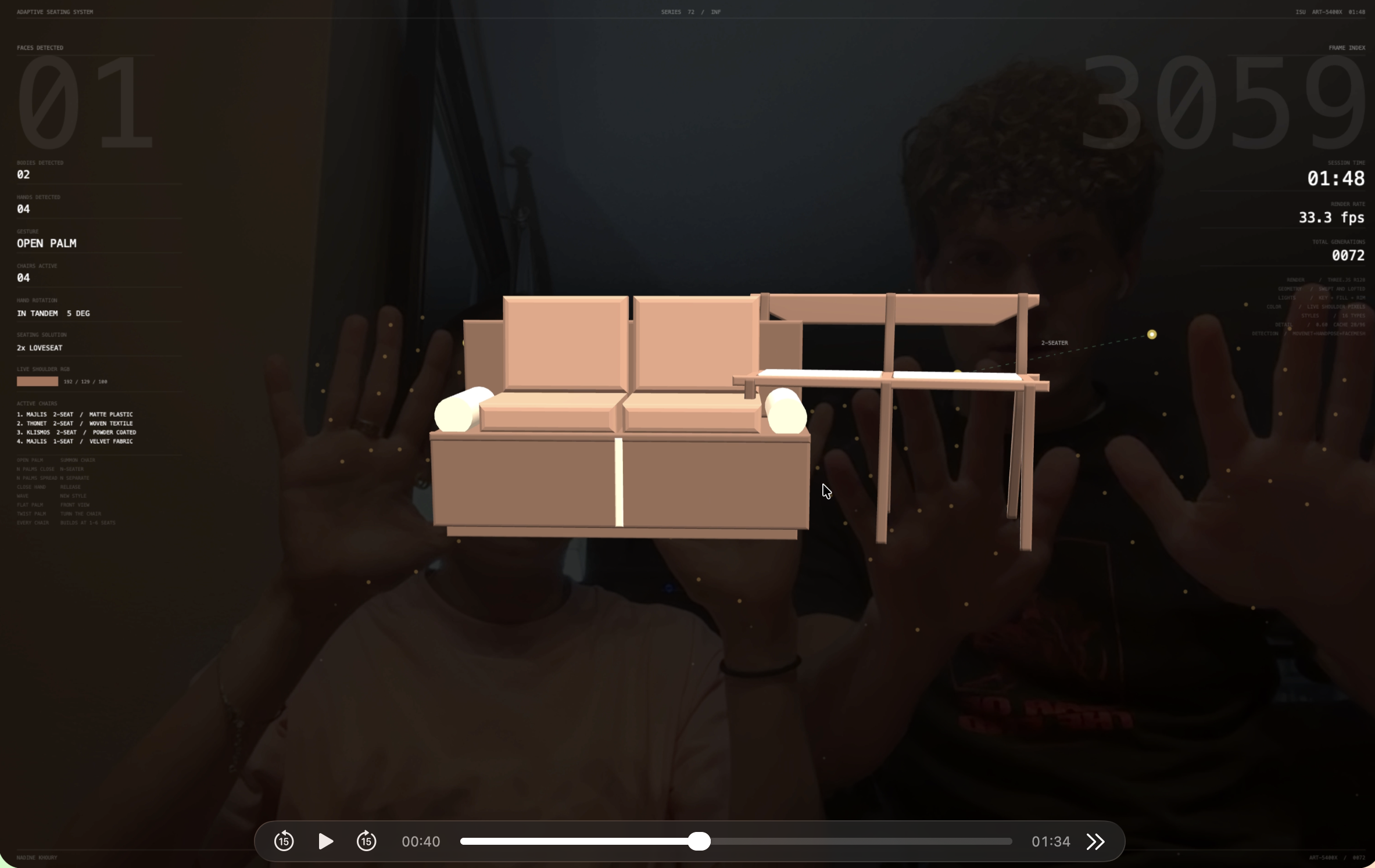
The video above showcases the newer [not final] furniture models, as well as a new feature I have been trying to explore and add. The chairs spin when people move their hands, so the system feels more dynamic. I have been trying to find a way to make it so that participants with their hands close together need to move their hands together to get the chairs to rotate, but that is proving harder than simply getting them to spin. This will take more time and needs more refining overall.
Before
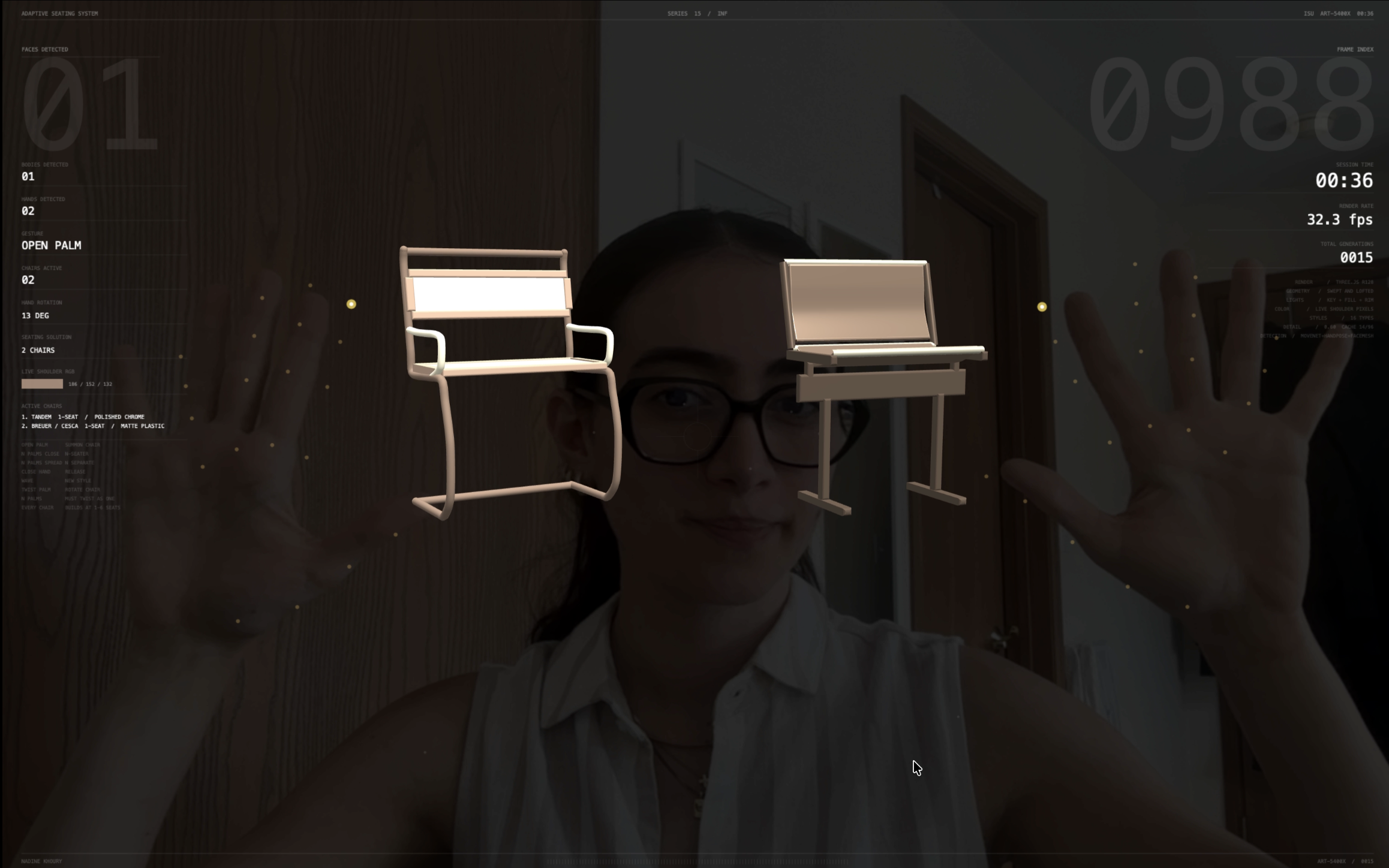
After [Still in progress]
The newer models still feel primitive; the next step is figuring out how to bevel the edges, add smoother transitions, and create more realistic-looking connections. Better texture and color will also help make them look more realistic - it is definitely an improvement from where the furniture was previously, but not where I want it to be yet.
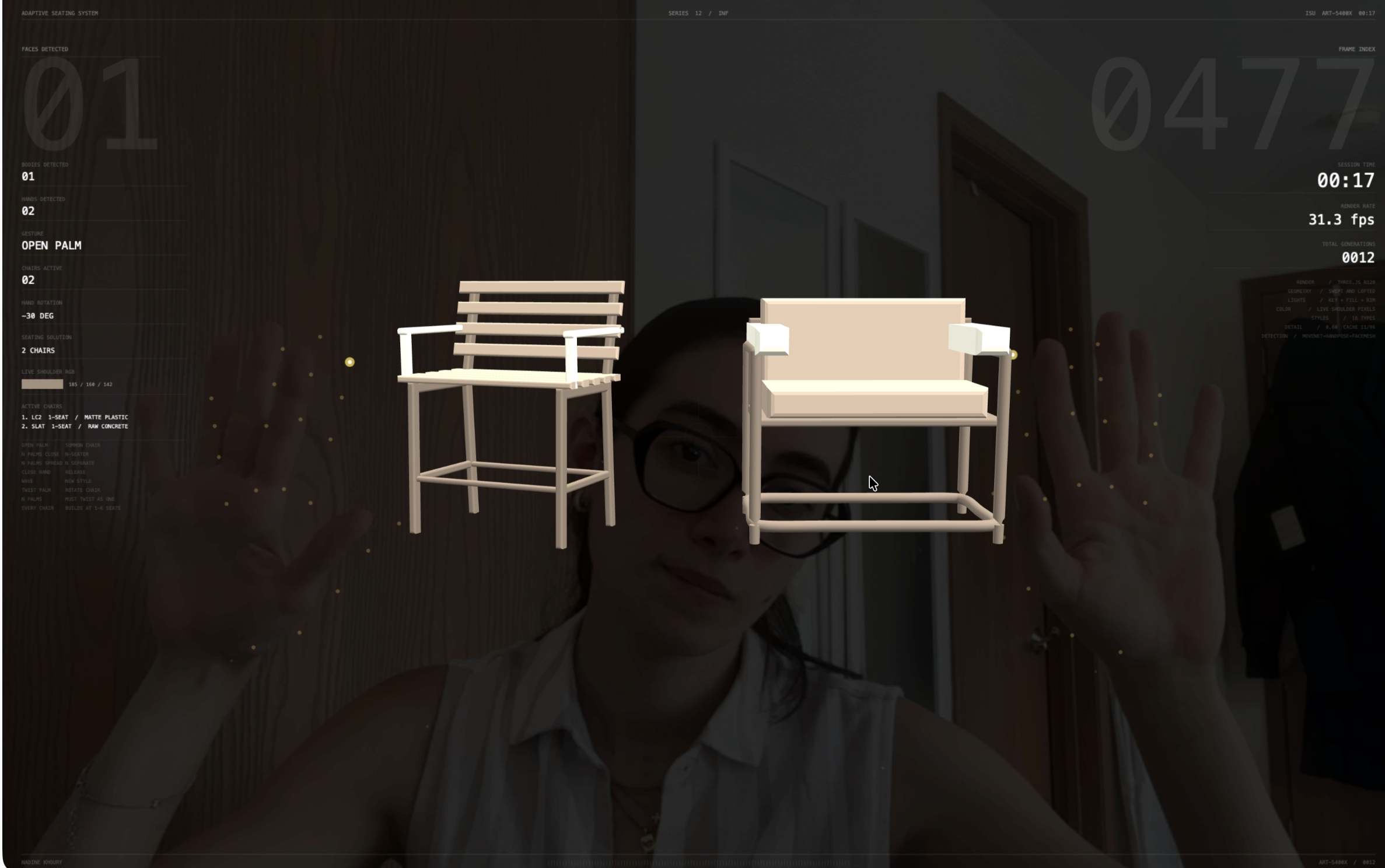
After [Still in progress]
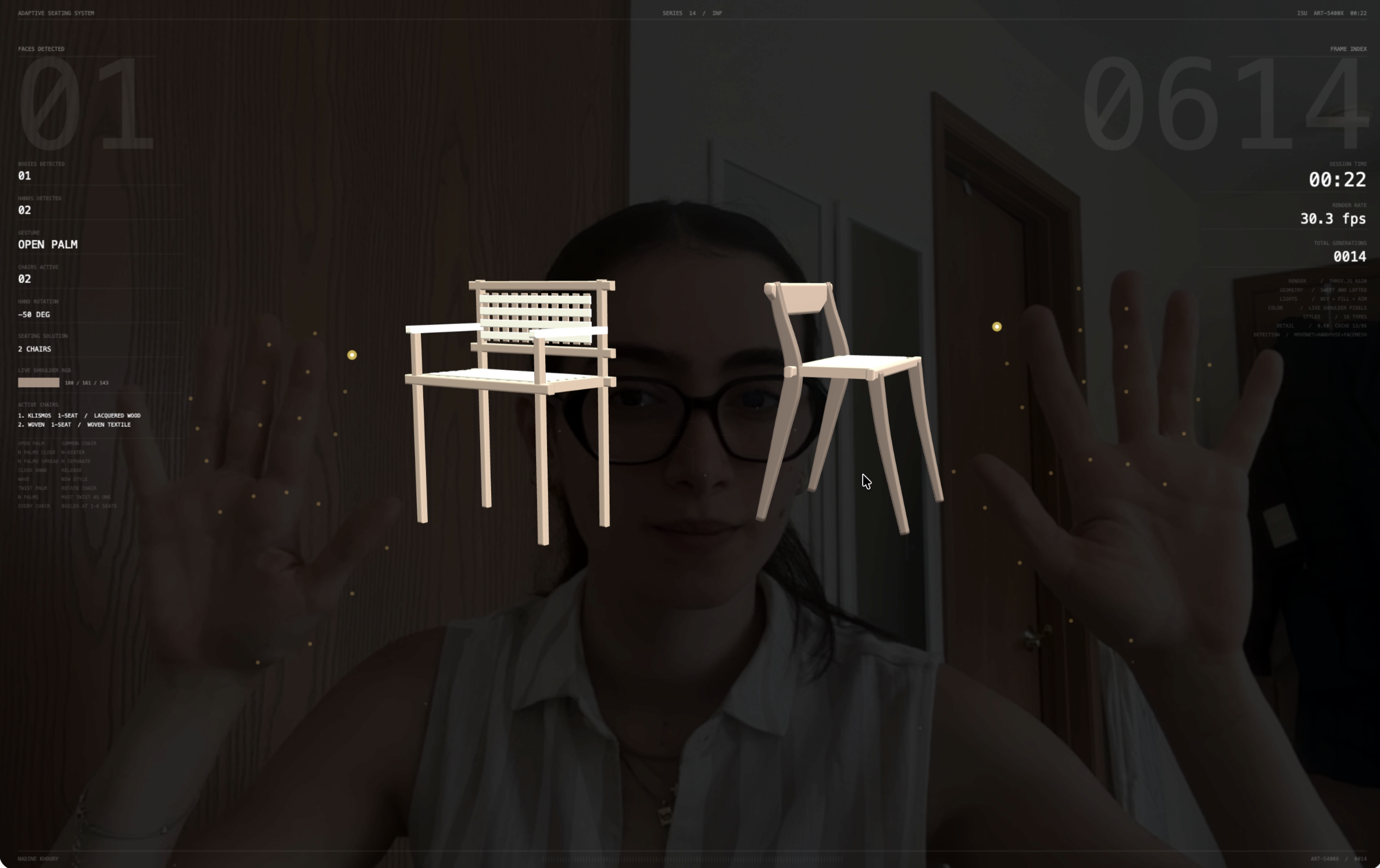
After [Still in progress]
A few hours later -
The addition of the spin feature might have caused some issues with the system - the camera seems to have trouble recognizing hands when there are more than 2, and the system also did not recognize that there was more than one person (testing in different lighting & different distances from the screen).
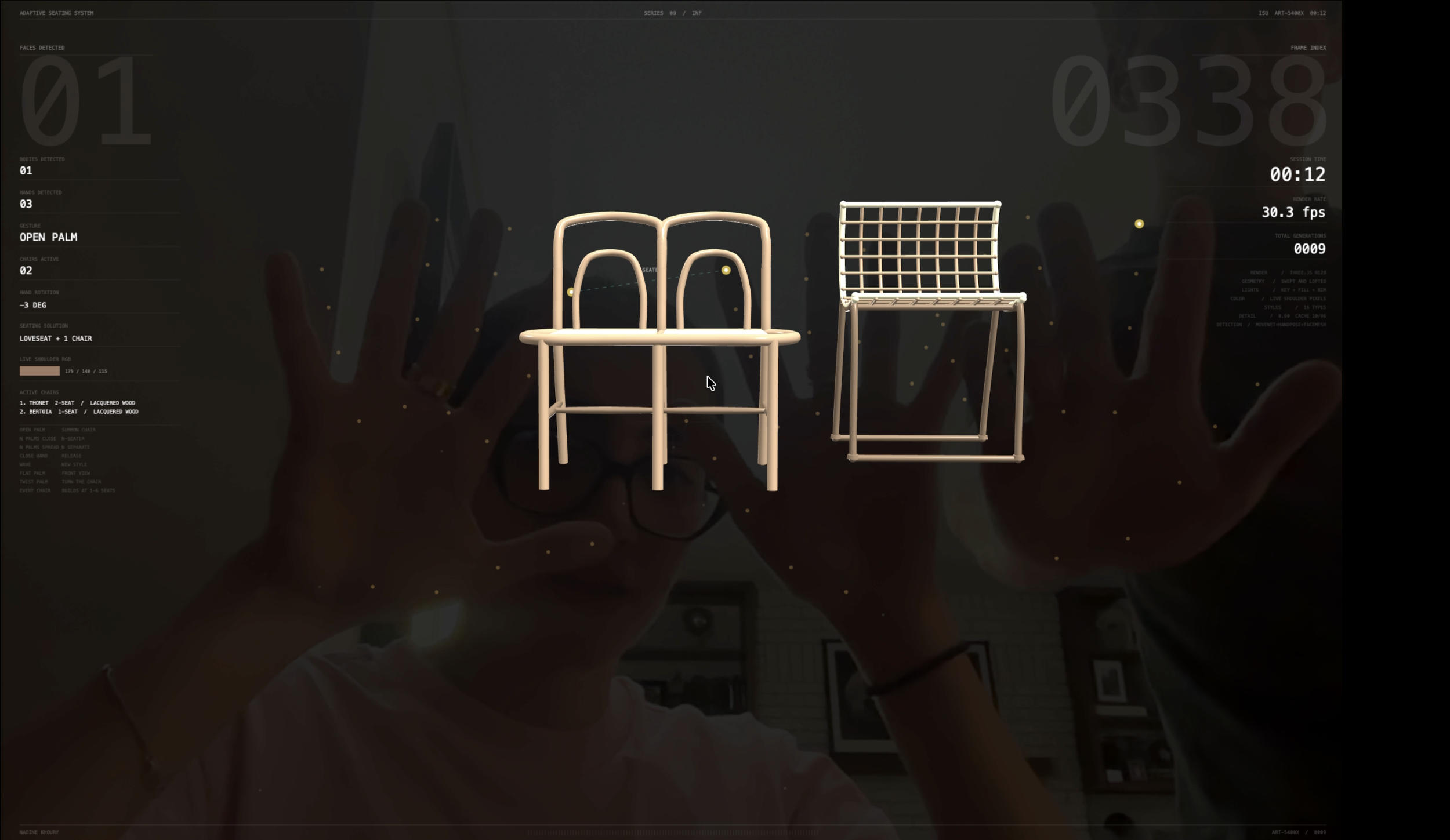
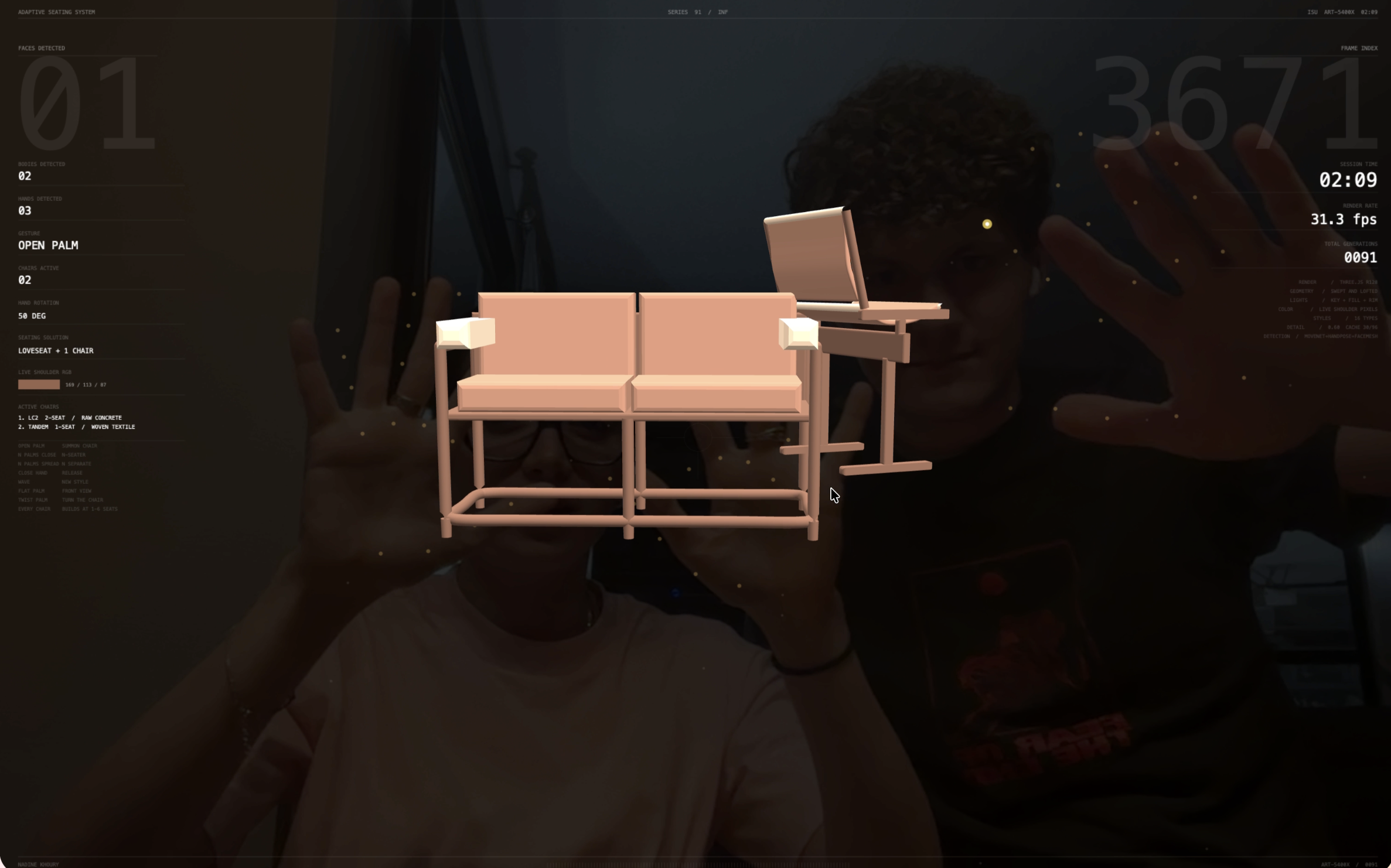
Addressing earlier list - “Some changes to be made/to-do list:”
Chair models have been redesigned - need further adjustments and work
The ghost issue is no longer a problem; I am now facing a different issue where the system is not recognizing all the people ( but no extra people are being counted)
Increasing text size & removing any unnecessary data displayed on screen has not been addressed yet. In a meeting with Johnny Diblasi, one of my committee members, the discussion shifted to adding the data and statistics to the rest of the work instead of removing them from this one [no final decision has been made yet].
HALF DONE
NEW PROBLEM
IN PROGRESS
2 more options - Furniture installation [ all titles & names need workshopping]
Thursday, September 10 -
Option 02 -
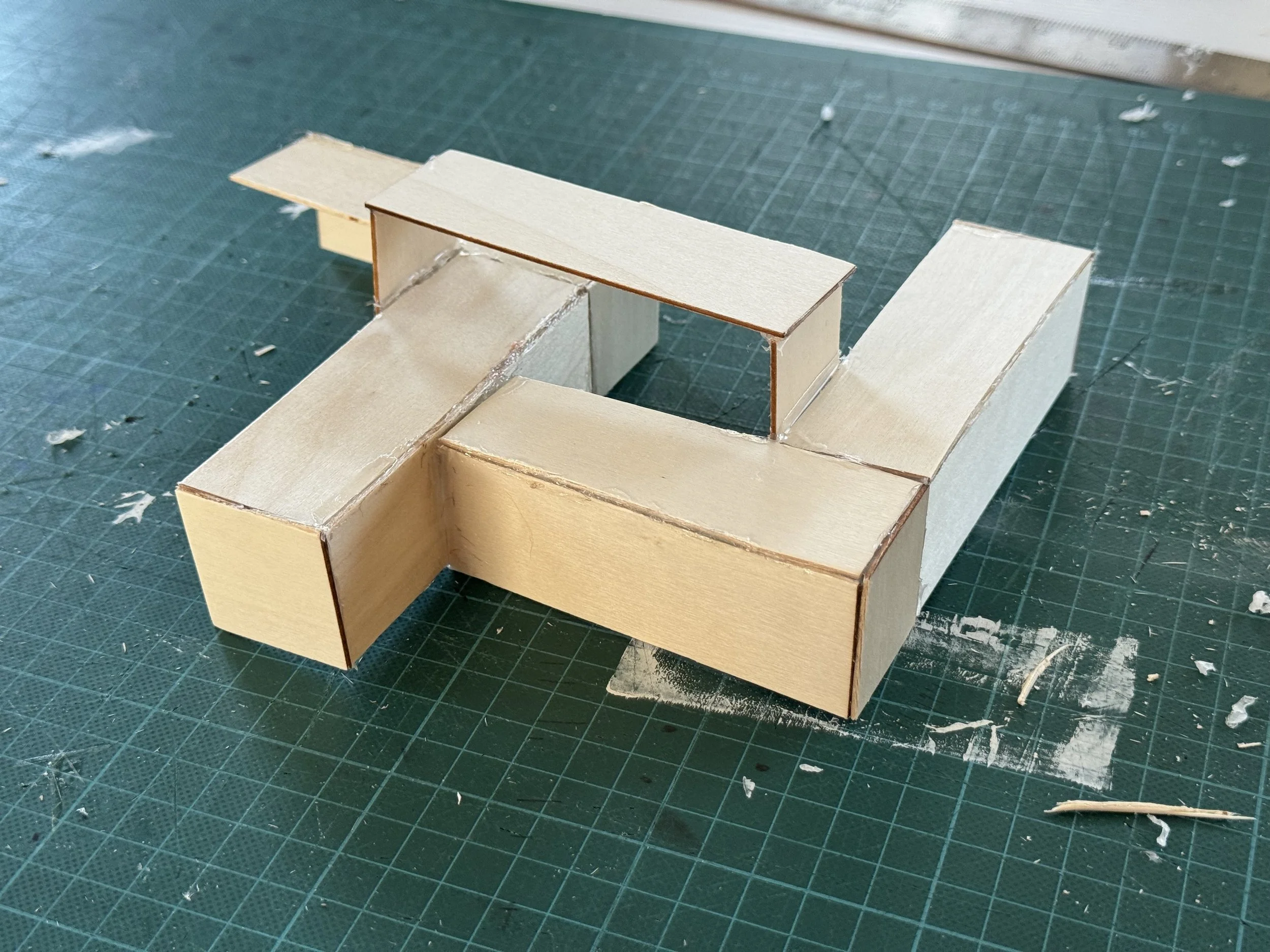
Option 03 -
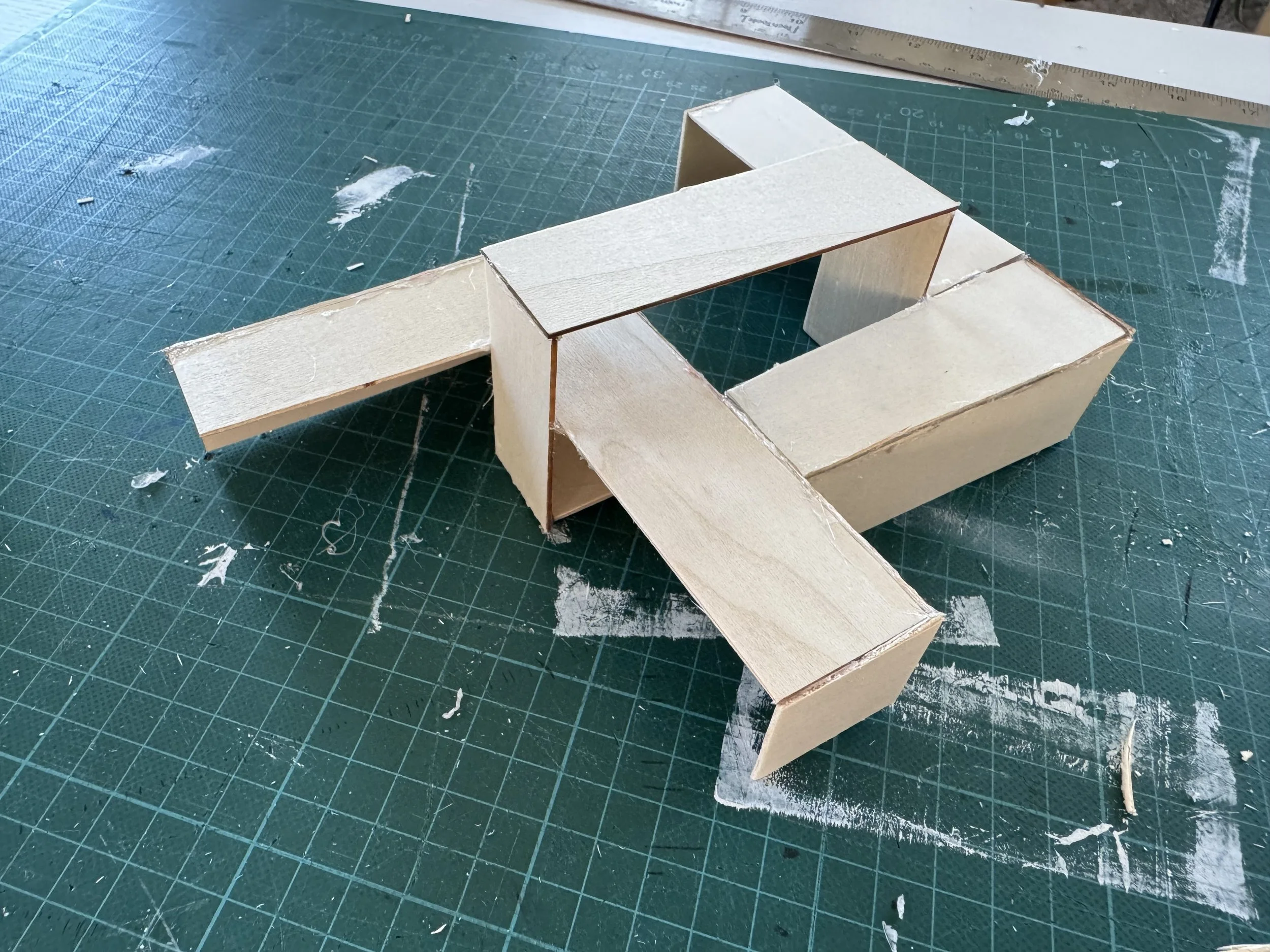
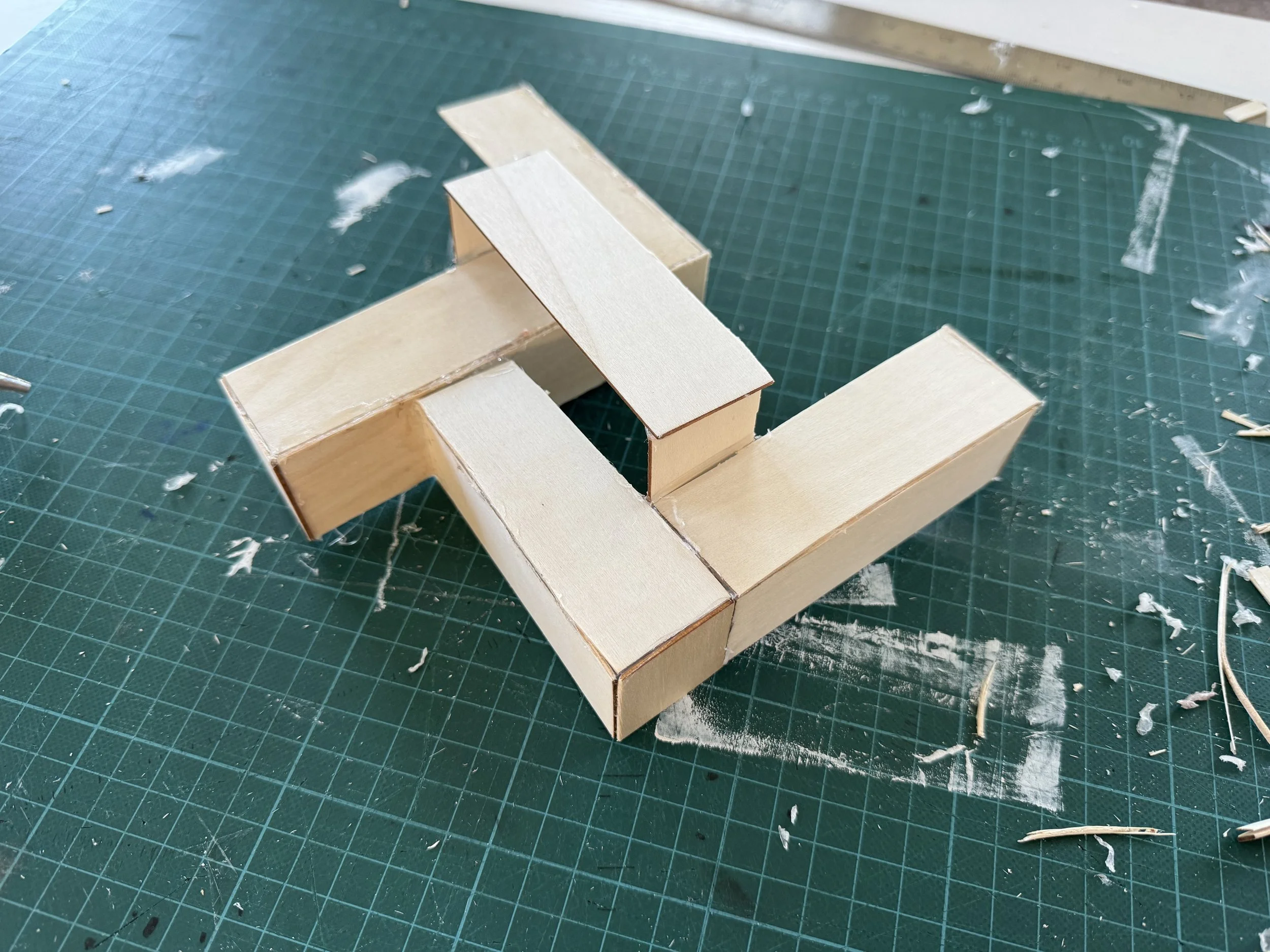
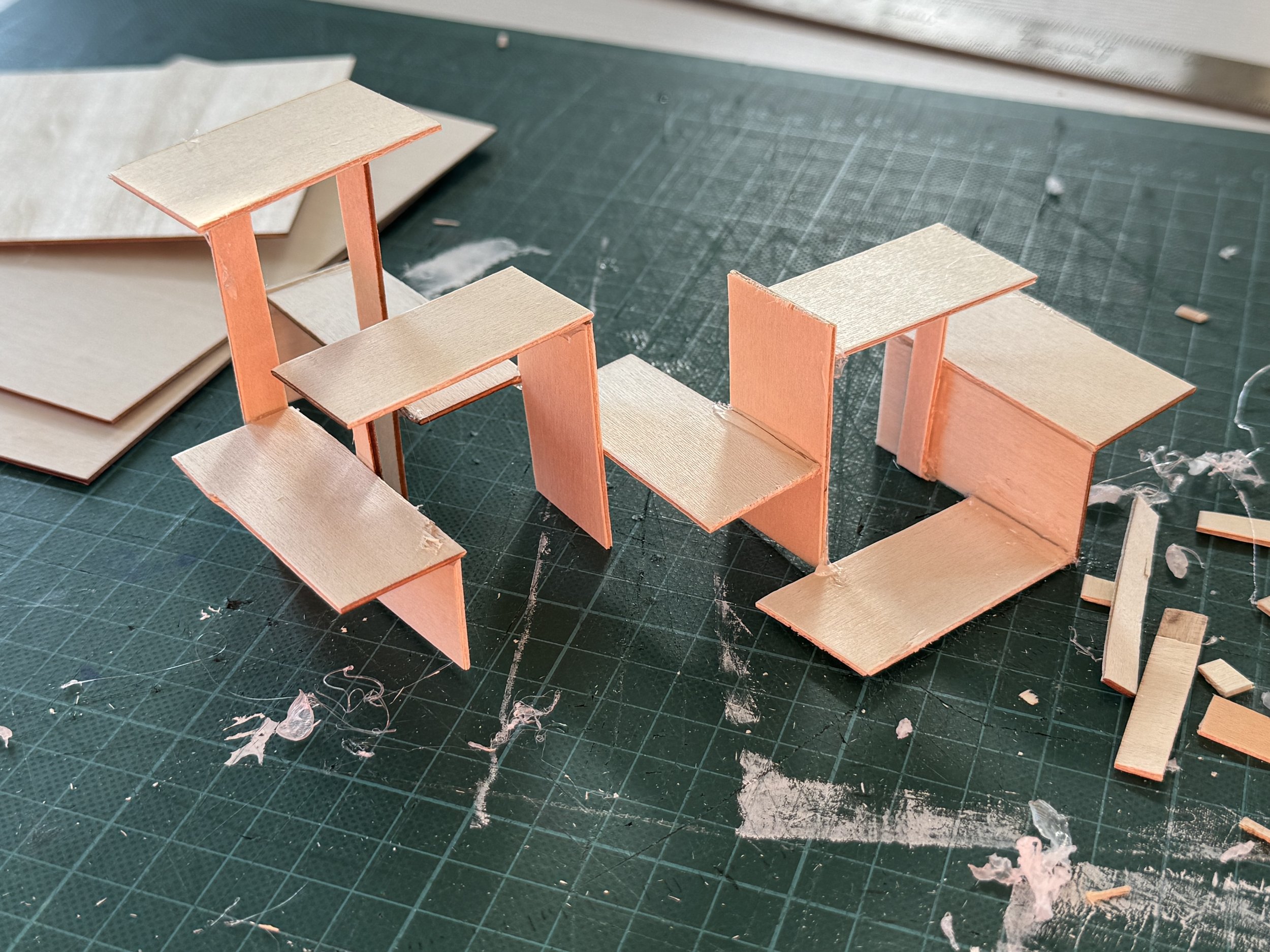
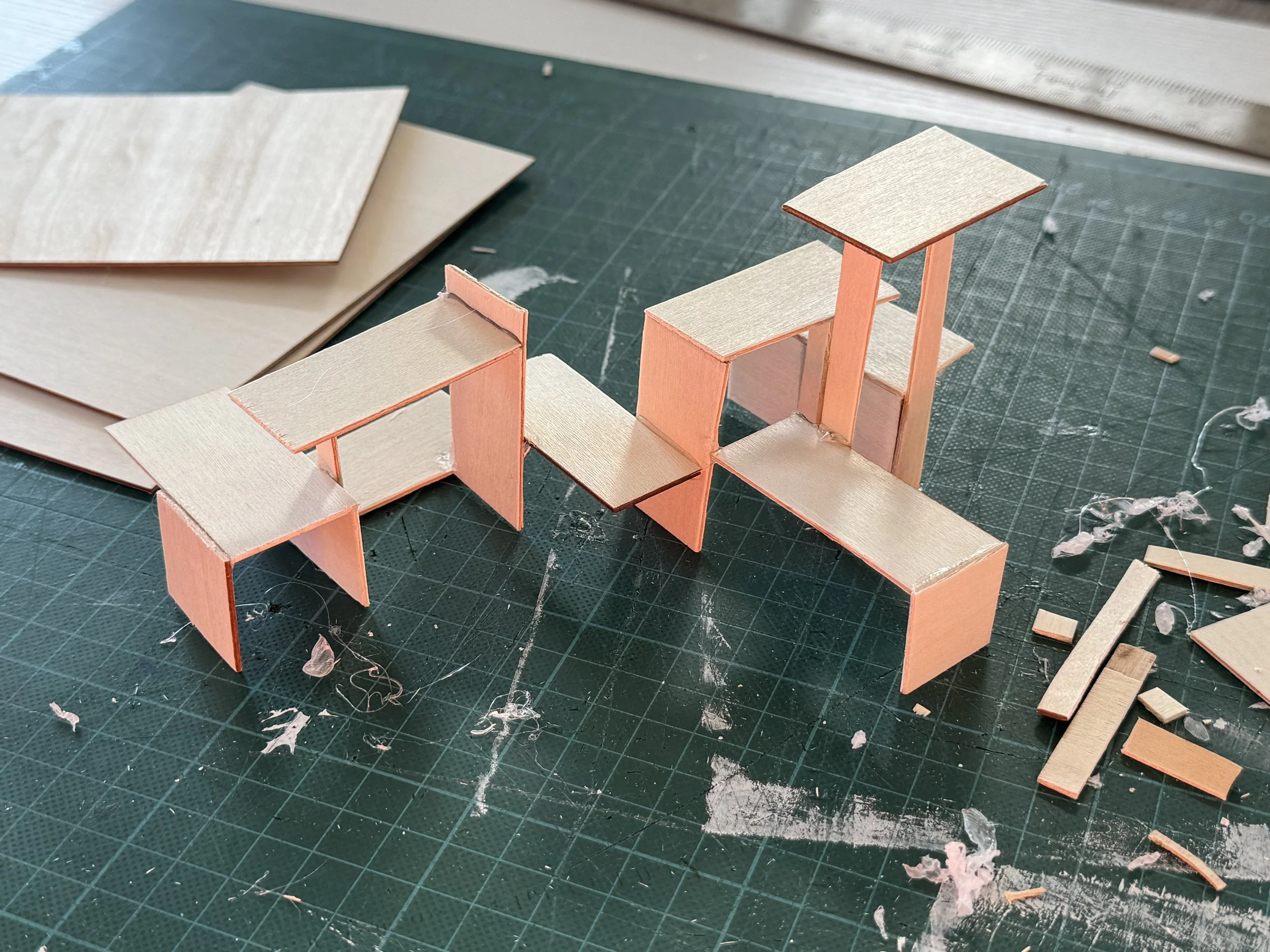
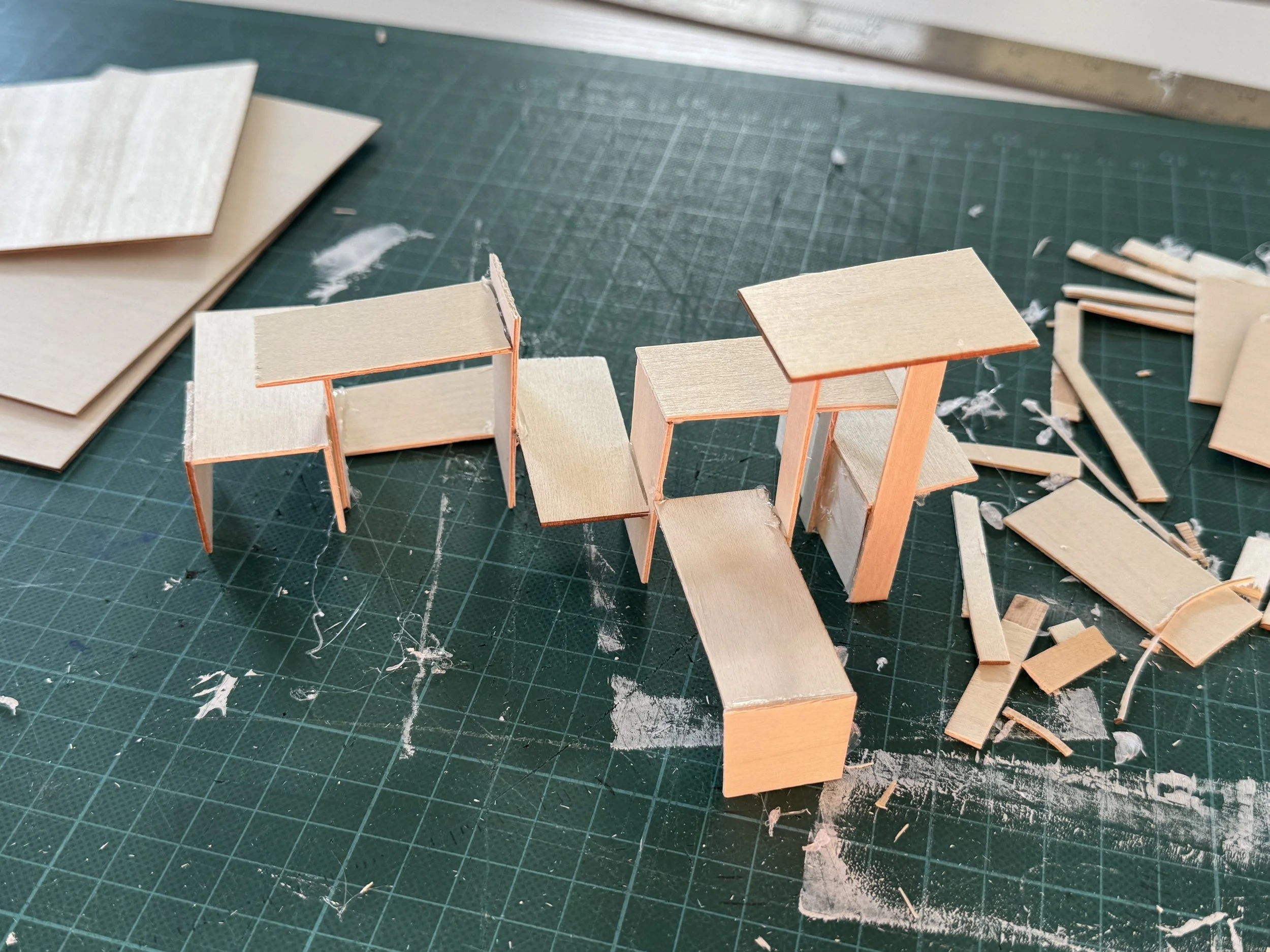
All three options side by side:
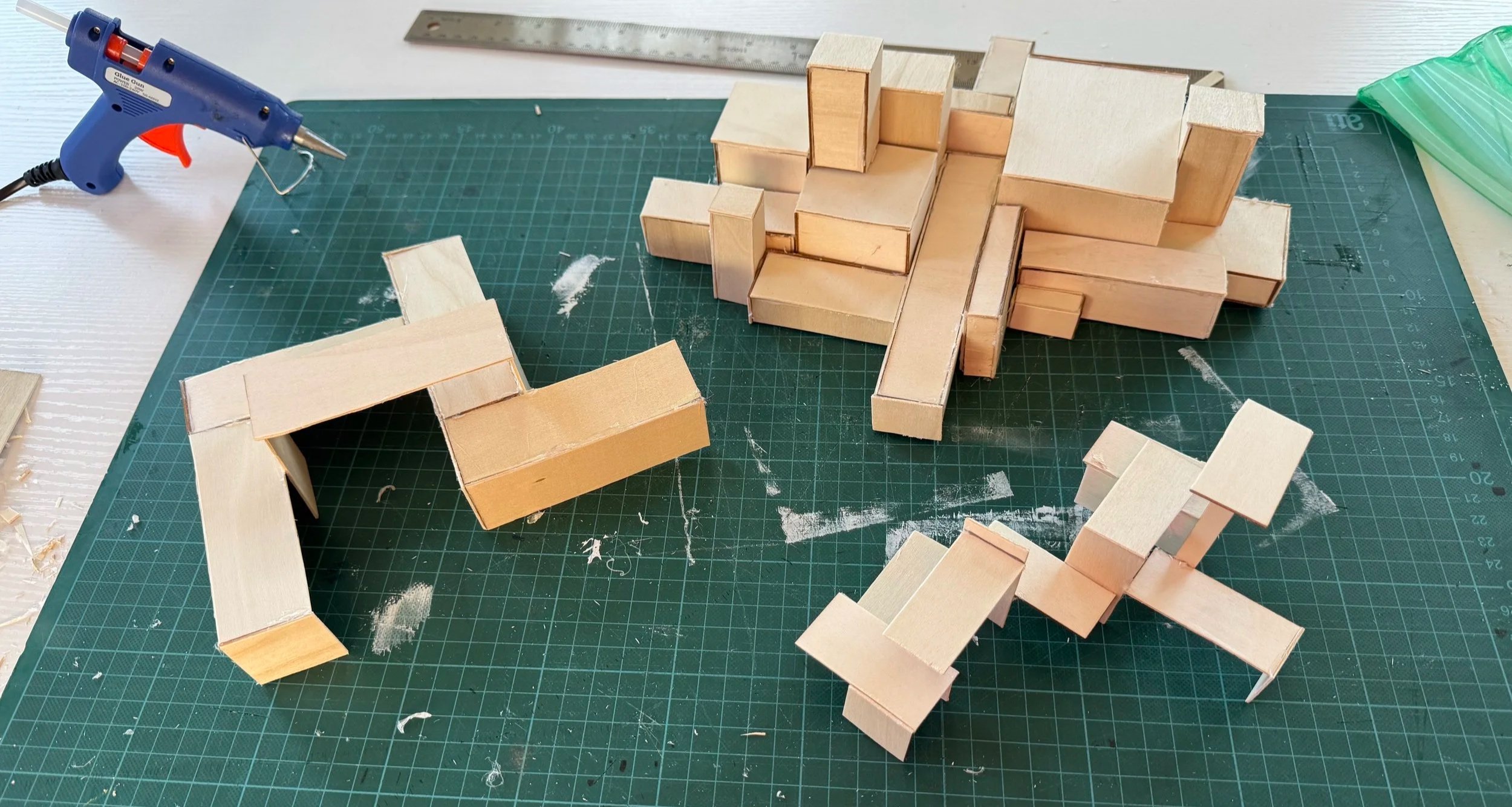
Option 02, Option 01 (Week #02) & 03 - [left to right]
None of these designs have achieved the desired effect. Next, I'll 3D model all these solutions, refine them, use accurate measurements, choose materials & calculate where, how many, and how the pressure sensors will be placed, then incorporate that into the design.
These quick sketch models taught me more about what I don’t want than what I do want, which is a great first step! [Models not properly scaled]
Extra option made from scrap materials -
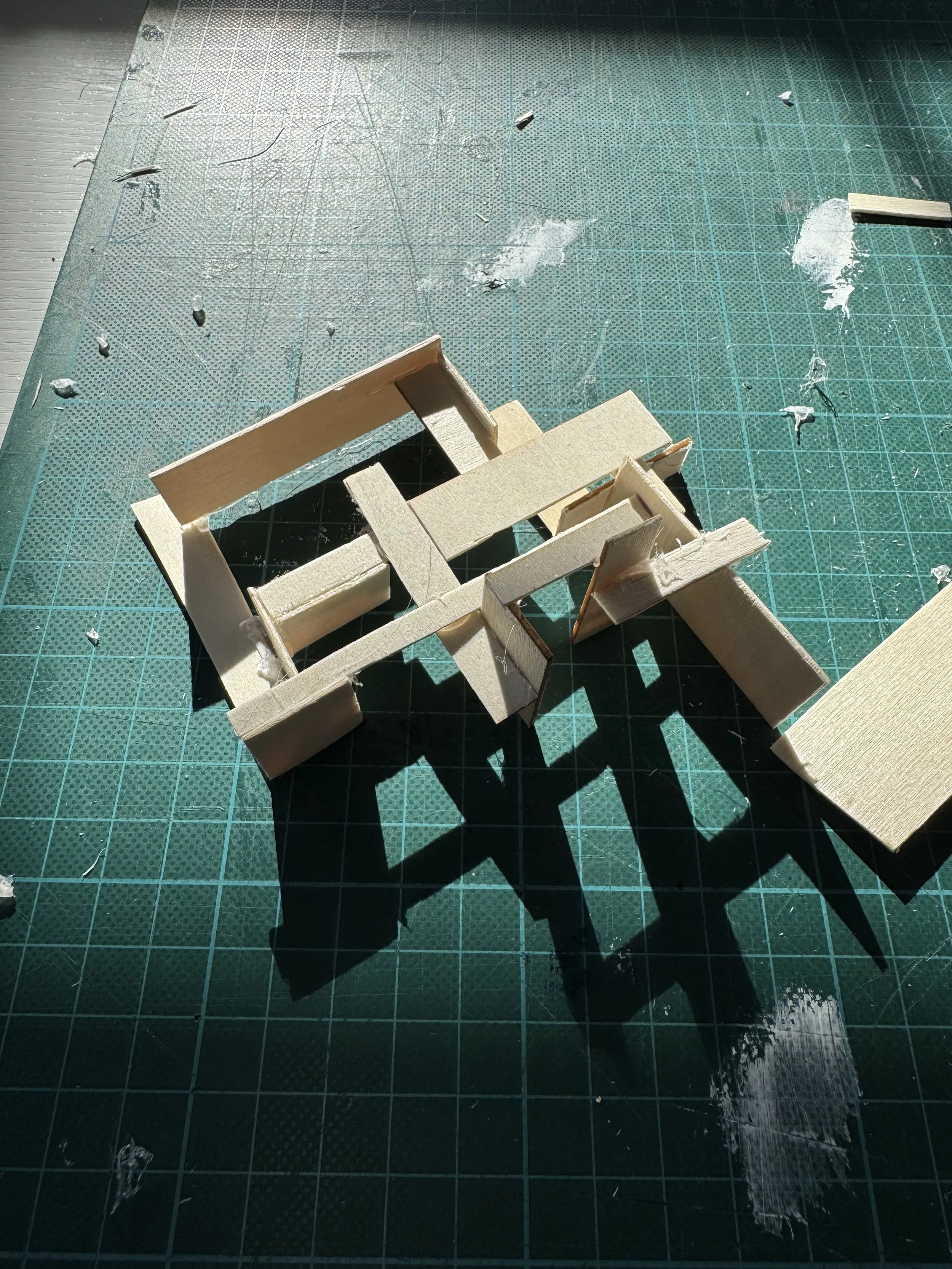
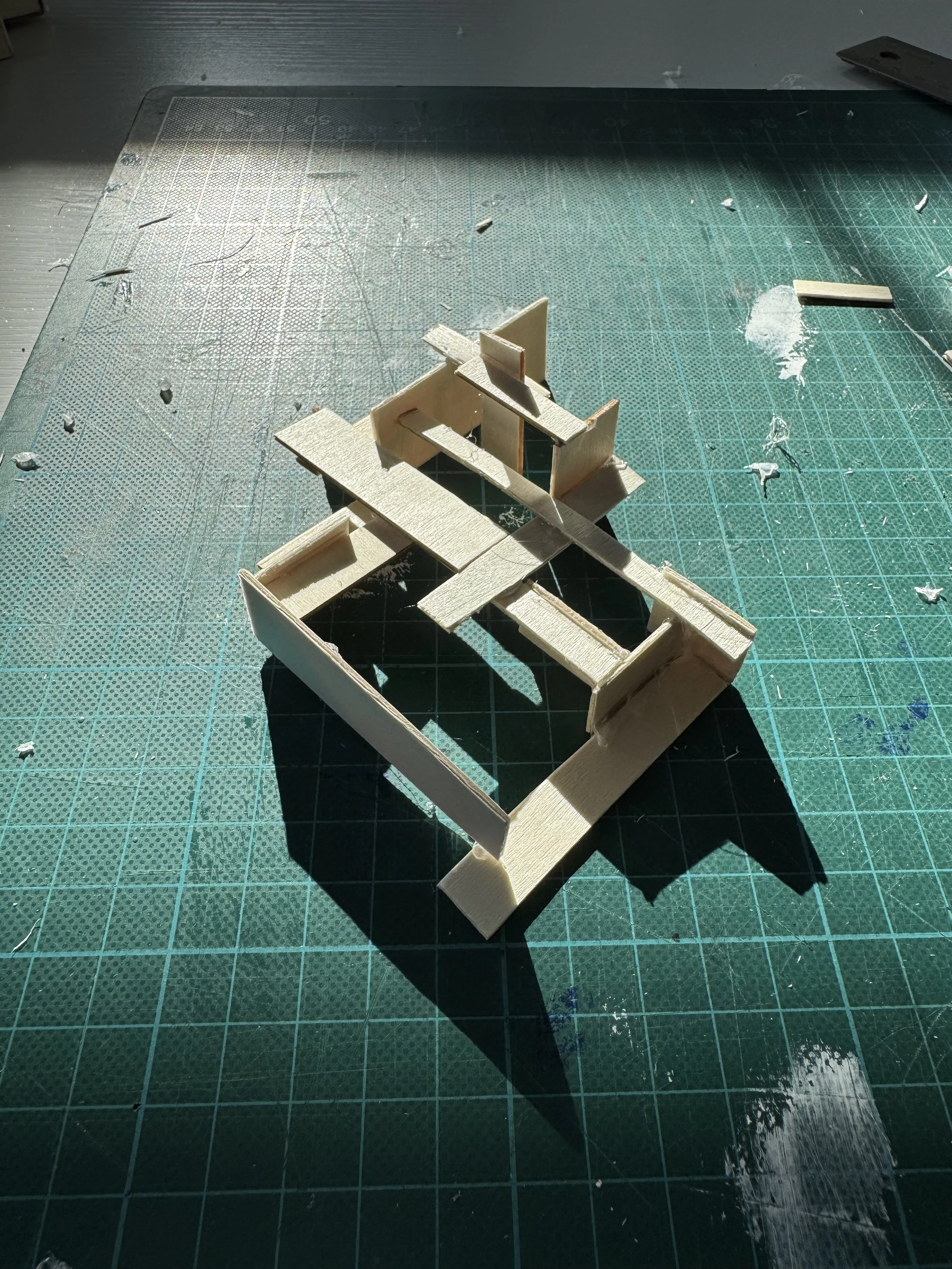
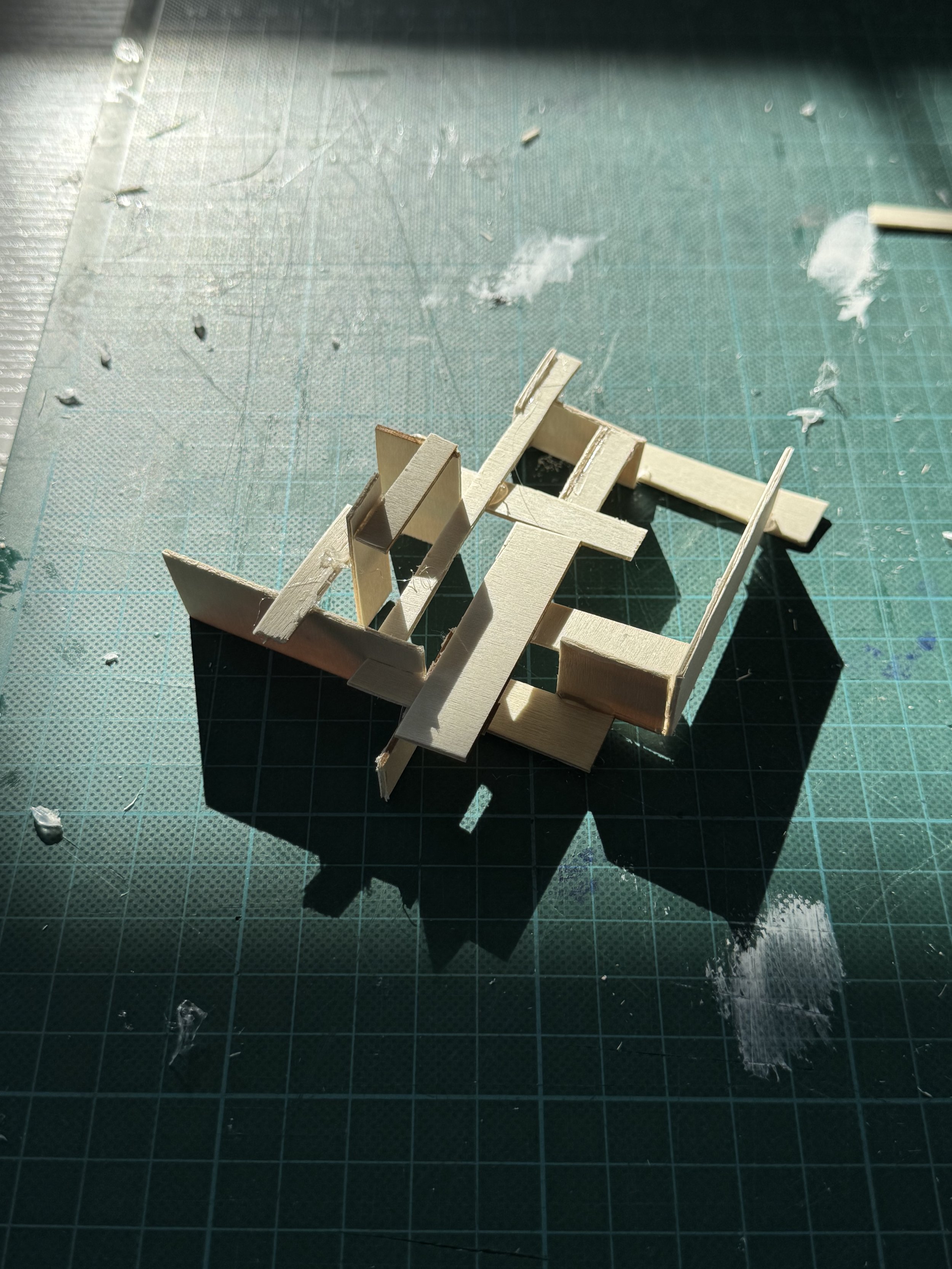
Confusing, but somehow a more interesting and dynamic solution; it looks more casual, which I think makes it more inviting in some ways. I think a more casual solution would invite more play and comfortable interaction. It needs to be revisited like all the others, since people would need to step over a lot of ledges to sit down. Will be 3D modeled and showcased in next week’s post.
WHAT I READ, WHAT I WANT TO READ & BOOKS I PURCHASED
Friday September 11 -
Project I found interesting this week! Grandy Four Streets
https://assemblestudio.co.uk/projects/granby-four-streets-2
“Characterized by celebrating the value of the area’s architectural & cultural heritage, supporting public involvement, & partnership working”
WHEN CITIES AREN’T PLAYABLE
-By Allison Stenning
https://www.mediapolisjournal.com/2025/11/cities-playable/
“An alternative to the Smart City, less interested in efficiency and profitability and more fascinated by spontaneous and messy encounters.”
PLACING PLAY AT THE HEART OF CITIES
-By Thom Atikson
https://www.citymonitor.ai/analysis/placing-play-at-the-heart-of-cities/?cf-view
THE ARSINAL OF EXCLUSION AND INCLUSION
A book about accesibility in a build environment.
https://www.interboropartners.com/projects/the-arsenal-of-exclusion-inclusion
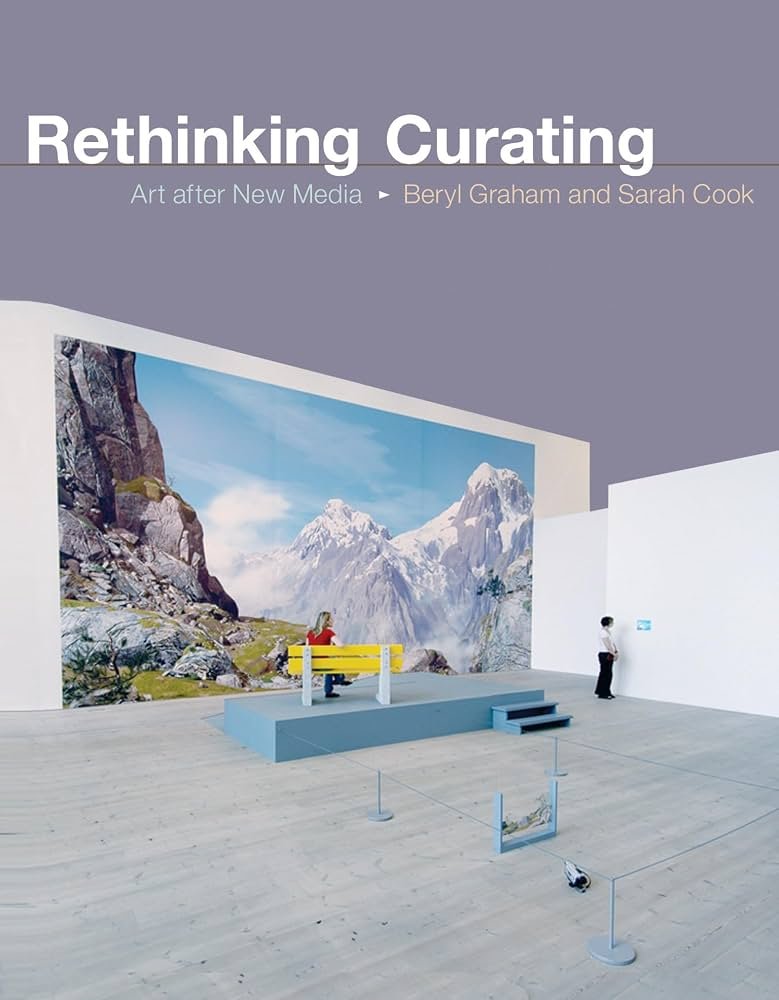
Rethinking Curating: Art After New Media - by Beryl Graham and Sarah Cook
Recomended by Committee member last week
The Art of Noticing: Rediscover What Really Matters to You - by Rob Walker
LAST WEEK’S [ WEEK #2 ] TO-DO LIST:
Design rugs and create finalized digital pattern sets based on finalized sizes + shapes
Order all necessary tufting supplies based on the inventory list (leftover materials from past projects)
Start on the physical process of the 1st Rug as soon as ordered items arrive
Build 2 more models for woodworking + 3D model, more finalized one
Saturday, Sep 5th
Saturday, Sep 5th
Change of plans!!
Wednesday, Sep 9th
COMPLETE
COMPLETE
N/A
COMPLETE
HIGH-PRIORITY TO-DO LIST ITEMS
Tuft small test rugs (to test color with projector) white vs beige (from inventory)
Look up projector rentals; find a good fit that could be rented again in March
Test P5.JS connection with MadMapper
Fix 2,3,4,5, and 6-seater chair output in interactive sketch
Thursday, Sep 17th
Thursday, Sep 17th
Tueaday Sep 15th
Monday, Sep 14th
IN PROGRESS
IN PROGRESS
IN PROGRESS
IN PROGRESS
+MORE ON EVERYTHING NEXT WEEK!
Thank you :)